Introduction
The UW Taskforce on the Future of PhD Education was convened as a joint initiative of the Provost and the Graduate School to chart innovative and proactive directions for PhD education at the University of Washington. As a leading R1 institution, UW seeks to model best practices in preparing the next generation of leaders, researchers and innovators while advancing its public mission. Joy Williamson-Lott, Dean of the Graduate School, and Daniel Pollack, Divisional Dean of Natural Sciences in the College of Arts & Sciences, served as co-chairs.
The Taskforce was charged with developing a forward-looking vision for PhD education that responds to evolving workforce demands, student needs, institutional priorities and fiscal realities. Its work focused on three core themes: (1) ensuring PhD students get the type of education, training and experiences they need for the current and future job market, including outside academia; (2) ensuring the UW has a vision for PhD education that fits with our R1 goals, public mission and fiscal challenges; and (3) ensuring UW graduate students are getting a high quality experience in their programs.1
In fulfilling this charge, the Taskforce was asked to envision what success looks like for PhD education at UW, develop actionable recommendations to support both near-term improvements and long-term transformation and determine where common institutional expectations should be established alongside appropriate program-level flexibility.
1 The following doctoral degree programs were out of scope for the taskforce: EdD, MD, PharmD, DDS, and JD. Therefore, “PhD” and “doctoral” are synonymous for the purposes of this report. Also, the UW Bothell campus does not currently have PhD programs. Therefore, the report focuses on UW Seattle and UW Tacoma.
The Taskforce’s work took place within a rapidly evolving national landscape for PhD education. Regular calls to diversify the career outcomes for PhD students so they are prepared to enter roles inside and outside academia reached a crescendo (Colby, 2023; CGS, 2025); the federal government’s attacks on the research enterprise through funding cuts, restrictions on international student duration of status and proposed caps on indirect costs destabilized student recruitment and retention efforts (Lu, 2025; Palmer, 2025; U.S. Department of Homeland Security, 2026; Quinn, 2026); and the federal government’s hostility toward equity initiatives threatened to undermine the role of higher educational institutions in society (U.S. Department of Education, Office for Civil Rights, 2025; Executive Office of the President, 2020; Executive Office of the President, 2025). All the above, and reduced state support, have local implications for PhD education at the UW (McNichols, 2026).
Within this context, several cross-cutting challenges emerged as central to UW’s ability to sustain excellence in PhD education:
- Alignment with future career pathways: ensuring PhD training remains relevant to a broad and evolving job market, including roles beyond academia
- Clarity and coherence of program structures: aligning curricula, milestones and co-curricular experiences with future-oriented training goals
- Sustainability and resource alignment: balancing financial constraints with cohort size, funding models and instructional and research needs
- Consistency and quality of student experience: addressing variability in mentoring, program expectations and student support across units
- Holistic student development: strengthening training in areas such as interdisciplinary work, responsible research, leadership, communication and professional development
- Student wellbeing and belonging: ensuring PhD education environments support community and inclusion
These challenges highlight the need for a more coordinated, transparent and future-oriented approach to PhD education across the institution.
The Taskforce used a multi-phase process to produce recommendations that are evidence-based, practical to implement and grounded in UW’s realities. A central steering group coordinated focused working groups—faculty, staff and PhD students spanning many disciplines from the Seattle and Tacoma campuses—charged with analyzing priority areas within the Taskforce mandate and developing targeted findings and recommendations. Stakeholder engagement was central throughout, drawing input from PhD students, faculty, program leaders, staff and administrative partners through town halls, interviews and structured feedback. That feedback was combined with institutional data, peer benchmarking and emerging national practices in PhD education. Work progressed through repeated cycles of analysis, synthesis and refinement to test ideas, surface barriers and align implementation considerations across themes. The product is an integrated set of institutional priorities and recommendations. Full details on governance, engagement, methods and timeline can be found in the Appendix: Project Planning & Execution.
The working groups organized their recommendations using a template that included priority level (high, medium or low), the unit responsible for implementation, implementation difficulty (easy, moderate or high; short-, mid- or long-range), rationale for the recommendation and implementation notes to facilitate uptake. Implementation difficulty reflects the anticipated level of effort, resources, coordination and time required for successful adoption. Recommendations are aligned with expected implementation horizons: short-range actions can typically be completed within one year, mid-range actions within three years and long-range actions require three or more years to achieve meaningful implementation and impact. This framework is intended to support prioritization, clarify ownership and provide a realistic pathway from recommendation to action.
Turning these recommendations into results will take coordinated work across central administration and academic units, backed by sustained faculty, staff and administrative engagement. Clear ownership aligned policy and procedures, academic unit buy-in, thoughtful resourcing, consistent communication and phased rollout will be essential to drive adoption and avoid uneven implementation.
This project made clear that the faculty and staff who support our PhD students are committed to providing a high-quality education and experience, and many of the recommendations were drawn from or inspired by current practice in our excellent programs, departments, schools and colleges. The Taskforce members were gratified to learn about all the ways we seek to support our students and eager to share those lessons and other lessons drawn from various sources with the entirety of the UW community.
The Taskforce committee believes that PhD education sits at the heart of UW’s research and educational mission. By addressing persistent structural barriers and investing in a more consistent, equitable and transparent PhD experience, UW has a timely opportunity to strengthen program quality, student outcomes and institutional impact. The Taskforce invites UW leadership and academic units to use this roadmap to prioritize early, feasible actions within existing structures and build sustained momentum for longer-term improvements.
If adopted, the Taskforce’s recommendations will help UW strengthen PhD education for today’s realities and tomorrow’s demands, advancing the University’s public mission while sustaining research excellence.
Anticipated impacts include:
- A future‑ready PhD experience that prepares graduates for diverse careers through intentionally designed skills, experiences and networks;
- Clearer, more consistent program expectations, milestones and definitions of success;
- A stronger and more reliable student experience through improved mentoring, advising and coordinated support;
- Better alignment between resources and program design, balancing fiscal constraints with educational and research priorities;
- A culture of continuous improvement supported by meaningful metrics and data‑informed decisions; and
- A deeper, more consistent commitment to equity, inclusion and student wellbeing across the doctoral lifecycle.
An overarching theme running through the report is the need for clearer and more robust graduate student handbooks at the department- or program-level. The Graduate School seconds this need as our own data demonstrates how that lack of clarity can lead to academic grievances, lengthen time-to-degree and decrease the quality of experience for graduate students. In several instances, this report points to a desire for the Graduate School to create additional resources for graduate student handbooks that can be customized to fit local contexts. The Graduate School is committed to doing so, with the help and advice of stakeholders, over the next few years. This is one of the best ways to realize the Taskforce’s recommendations at scale while positively influencing the experiences of our PhD students.
We are at a pivotal moment in the United States higher education landscape, and colleges and universities must take control of their futures in ways different than in the past. The UW is uniquely positioned to lead in this space, especially in charting a vision for the future of the PhD. Our reputation and standing require we do so: first among public institutions in receiving federal research funding, second among Global Universities rankings and a $21 billion-dollar economic impact on Washington State and wider impact on the regional economy (University of Washington Office of Planning & Budgeting, 2013; University of Washington External Affairs, n.d.; University of Washington News, 2025).
In the coming years, UW will serve as an example of thoughtful, evidence-based innovation in doctoral education, helping to chart a path for graduate training that meets the needs of students, employers and society. To do so, we must reevaluate, adapt and innovate PhD education to fit a changed context. Acting now will not only ensure the UW remains a magnet for bold and brilliant talent but provides a roadmap for other institutions to fuel success throughout the student lifecycle and to provide PhD education for a world that doesn’t stand still.
All substantive analysis, findings, recommendations, innovative ideas, toolkits and resources in this report were developed, reviewed and approved by the PhD Taskforce working group members, co-leads and co-chairs. AI tools were used to support selected editorial activities during its development with a focus on improving readability and clarity, including checks for grammar, formatting, standardization and redundancy.
Acknowledgements
Joy Williamson-Lott and Daniel Pollack, co-chairs of the Taskforce, would like to thank the faculty and staff listed below. They spent several hours reviewing material, hosting conversations and listening sessions, identifying areas for improvement and charting a path forward for PhD education at the University of Washington. We are especially gratified for their commitment to enhancing the experience of doctoral students and ensuring they graduate with all the education and tools necessary to be successful. The working group co-leads, especially, took on this task with enthusiasm and demonstrated leadership in visioning a future for the PhD. We are deeply grateful for their partnership.
We would also like to thank the PhD students who contributed to this work by serving on the steering committee, attending forums and submitting feedback through the web portal. Their perspectives on how to improve the quality of experience for future doctoral students provided a vital lens on the issues and will help hone how the UW moves forward in this space.
Many faculty and staff attended our Town Hall forums throughout the academic year and provided feedback through the web portal. Their feedback was critical to the working groups and to the larger project. These and other faculty and staff across the UW who are committed to finding ways to improve the PhD experience are how the recommendations will become reality.
Academic Progress & Success
| Name | Group status | Member status | Unit |
| Angel Fettig | Lead | Faculty | Education |
| Martine De Cock | Lead | Faculty | Engineering & Tech, UWT |
| Carolyn Baylor | Member | Faculty | Medicine |
| LeiLani Nishime | Member | Faculty | Communication |
| Jade Orr | Member | Faculty | Built Environment |
| Ellen Gregoire | Member | Staff | Political Science |
| Minh Vo | Member | Staff | Public Health |
| Mayumi Willgerodt | Ad hoc | Faculty | Grad School; SOM |
Career & Professional Development
| Name | Group status | Member status | Unit |
| Brandon Guthrie | Lead | Faculty | Global Health |
| Becky Corriell | Lead | Staff | Public Policy |
| Gerald Seidler | Member | Faculty | Physics |
| Juhua Hu | Member | Faculty | Engineering & Tech, UWT |
| Stefka Mihaylova | Member | Faculty | Drama |
| Mark Scheuerell | Member | Faculty | Environment |
| Rachel Arteaga | Member | Staff | Simpson Center |
| Jessica Roberto | Member | Staff | Business |
| Briana Randall | Ad hoc | Staff | Career & Internship Center |
| Jaye Sablan | Ad hoc | Staff | Grad School |
Community & Belonging
| Name | Group status | Member status | Unit |
| Maya Smith | Lead | Faculty | French & Italian Studies |
| Christine Noyes-Williams | Lead | Staff | iSchool |
| Corey Garza | Member | Faculty | Environment |
| Sarah Iribarren | Member | Faculty | Nursing |
| Jessica Werk | Member | Faculty | Astronomy |
| Joe Eckert | Member | Staff | Engineering |
| Ziyan Bai | Ad hoc | Staff | CIRCLE |
| Kalei Kanuha | Ad hoc | Faculty | Grad School; Social Work |
Funding
| Name | Group status | Member status | Unit |
| Patricia Kramer | Lead | Faculty | Anthropology |
| Marta Scatena | Lead | Faculty | Bioengineering |
| Bing Brunton | Member | Faculty | Biology |
| John Gennari | Member | Faculty | Medicine |
| Rona Levy | Member | Faculty | Social Work |
| Amy Orsborn | Member | Faculty | Engineering |
| Candice Rai | Member | Faculty | English |
| Ken Rice | Member | Faculty | Biostatistics |
| Trina Sterry | Member | Staff | Public Health |
| Helene Obradovich | Ad hoc | Staff | Grad School |
Mentoring & Advising
| Name | Group status | Member status | Unit |
| Payman Arabshahi | Lead | Faculty | Engineering |
| Chelsea Wood | Lead | Faculty | Environment |
| Alex Anderson | Member | Faculty | Built Environment |
| Douglas Ishii | Member | Faculty | English |
| Bill Mahoney | Member | Faculty | Medicine |
| Wanda Pratt | Member | Faculty | iSchool |
| Elizabeth Sanders | Member | Faculty | Education |
| Emily Bernet | Member | Staff | Public Health |
| Sarah Garner | Member | Staff | Mathematics |
Academic progress & success
The Academic Progress & Success working group was charged with rethinking how UW defines, supports and sustains academic and research excellence in doctoral education in response to rapid technological changes, evolving scholarly practices, diverse career pathways and shifting external landscapes. PhD excellence is a multidimensional construct emerging from the interaction of disciplinary knowledge, independent scholarship, intellectual and methodological rigor, scholarly communication, professional practices and the social context of PhD training. In this context, the group focused on articulating a forward-looking vision of PhD excellence that can guide programs in preparing the next generation of leaders, researchers and innovators.
The scope of this work centered on two primary goals. One, we sought to create recommendations that units establish clear, shared definitions of academic and research excellence that serve as a “North Star,” supported by actionable indicators, accountability practices and ongoing assessment of gaps and inconsistencies. Such local efforts should be related to a flexible, UW-wide framework that promotes clarity, equity and coherence in doctoral education. Two, we sought to identify strategies to break down disciplinary silos and equip PhD students with a common core of transferable, future‑ready skills across UW. This included assessing existing programming, identifying gaps and developing recommendations for scalable, cross-disciplinary approaches that promote transparency, equity, coherence and continuous improvement while allowing for local adaptation.
Variability in level of program structure
Across programs, PhD education reflects a spectrum from highly structured to highly individualized models, but all share a common core of milestones and developmental expectations. Structured programs emphasize sequenced coursework, cohort models and clearly defined benchmarks (e.g., theory exams, applied projects, dissertation), while more flexible programs rely heavily on advisor-guided, “build-your-own” course work/pathways with fewer formalized expectations. Hybrid models combine required coursework and milestones with strong, professional expectations such as publishing, teaching and conference participation. Across all fields, students are expected to develop deep and broad disciplinary knowledge, engage in independent research and communicate their work effectively. Notably, humanities and language-based programs foreground extensive reading, high-level literacy and rigorous qualitative inquiry, while STEM-oriented programs more explicitly prioritize publication output and technical rigor. Annual progress reports, milestone-based evaluations and early research experiences (e.g., inquiry projects, lab-based studies) emerged as common mechanisms for monitoring student development.
Promising practices supporting academic progress and success
Several promising practices emerged across programs that align closely with the goals of academic and research excellence. These include scaffolded early research experiences that intentionally build toward independent scholarship; structured yet flexible coursework models that balance disciplinary depth with interdisciplinary breadth; and formalized progress monitoring systems (e.g., annual reviews, milestone check-ins, committee oversight) that engage multiple faculty members in evaluating student trajectories. Programs that integrate teaching preparation, interdisciplinary coursework, public-facing scholarship and career preparation into doctoral training also demonstrate strong alignment with evolving career pathways for PhD graduates.
Transferable skills resources exist but are uneven
The working group identified substantial infrastructure supporting transferable skills development across the University. Campus-wide opportunities such as Scholars’ Studio, Three Minute Thesis (3MT), CoMotion programming, Graduate School professional development events, and LinkedIn Learning provide broad access to communication, public engagement, project management, entrepreneurial thinking and AI-related learning opportunities. At the program level, several departments have embedded transferable skills development directly into doctoral curricula through required seminars, pedagogy practica, professional development coursework and research presentation forums. Many programs within the University have demonstrated how sustained, credit-bearing structures can normalize transferable skills development as an integrated component of PhD education rather than an optional add-on.
At the same time, stakeholder input indicates that access to transferable skills learning opportunities varies substantially across programs and skill domains, resulting in uneven student experiences. Because most transferable skills training is optional, advisor-dependent, or program specific, students’ exposure depends heavily on local culture, faculty initiative and disciplinary norms. While areas such as communication, pedagogy and research ethics are relatively well supported in many units, others—including AI literacy, leadership and collaboration, and formal project management—rely largely on self-directed use of general platforms rather than PhD-specific training. This landscape suggests a significant opportunity for UW to better coordinate, align and elevate existing efforts so that all doctoral students, regardless of discipline, can reliably acquire a shared foundation of future-ready skills.
Unclear or hidden expectations for students
While PhD education at UW is widely viewed as excellent, the working group identified several opportunities to strengthen transparency and consistency surrounding academic and research excellence. A major theme across programs was the reliance on implicit or “hidden” expectations related to publications, teaching, professional development and scholarly productivity. These expectations are often communicated informally through mentoring relationships rather than clearly articulated program structures, contributing to uneven student experiences and ambiguity regarding what constitutes excellence. Although disciplinary flexibility is essential, lack of explicit expectations and standardized milestone communication can create inequities in students’ access to opportunities and understanding of pathways toward success. Additionally, while some systems (e.g., external dissertation review models) aim to increase rigor and accountability, they do not necessarily ensure higher quality and may introduce additional complexity. Overall, the findings suggest a need for greater transparency and clearer articulation of milestones, expectations and indicators of academic and research excellence across PhD programs, while preserving the flexibility necessary to support diverse disciplinary norms, scholarly approaches and student career pathways.
- The Graduate School and other central units should better collaborate and communicate existing resources for career and professional development.
- Priority: Medium
- Responsible unit: Graduate School and campus career centers
- Implementation difficulty: Moderate; mid-range goal
- Rationale: The Graduate School and the career centers at Seattle and Tacoma, should coordinate regarding their programming and resources for universal career and professional development needs for PhD students and provide resources at the highest level of centralization that maximize efficiency and effectiveness. Such offerings will be necessarily broad to appeal to all PhD students, but they will ensure that all students have some access to career and professional development.
- Implementation notes:
- The Graduate School should work with campus career centers, which primarily focus on supporting undergraduates, to create and offer more programming and resources applicable to PhD students. Partnering on providing those services, perhaps with additional joint programming like the Graduate School’s Exploring Professions Beyond Academia Summit, will ensure that PhD students can access useful information from experts.
- When identifying the programming and resources PhD students need, the Graduate School and other central units should consult with academic units, alumni and other stakeholders.
- The programming and resources should be aligned with the transferable skills self-assessment tool mentioned in the Academic Progress & Success section of this report.
- The Council of Graduate School’s PhD Career Pathways project and materials should be leveraged.
- See Toolkits B and C for related suggestions on providing students with transferable skills.
- Programs should be encouraged to leverage and grow existing school- and college-level resources, increase student usage and regularly assess their offerings to ensure students receive the education and experiences that set them up for success in a variety of careers.
- Priority: Medium
- Responsible unit: Schools and colleges
- Implementation difficulty: Moderate; mid-range goal
- Rationale: Career and professional development advising services within schools and colleges are best positioned to identify which activities, skills and resources prepare their students for success in a variety of careers. They are also best positioned to encourage student usage, to adapt services as necessary and to provide customizable resources for use at the PhD program-level.
- Implementation notes:
- Schools and colleges should leverage central resources so they do not duplicate effort. PhD programs could modify the transferable skills self-assessment tool mentioned in the Academic Progress & Success section of this report to devise locally appropriate experiences and resources.
- Students should be encouraged if not required to participate in career and professional development at the school- or college-level. Such activities could be integrated into coursework, seminars, informal meet-and-greets with alumni or other low-barrier experiences.
- Schools and colleges should be attentive to inclusive messaging since some informal messages within PhD programs reinforce perceived hierarchies among career options, especially about the worth of careers outside academia.
- Schools and colleges should regularly reassess their offerings to ensure they continue to meet student needs.
- Schools and colleges are encouraged to track and learn from PhD graduate career pathways and link current students to alumni and other networks.
- Priority: Medium
- Responsible unit: Schools and colleges
- Implementation difficulty: High; long-range goal
- Rationale: While some schools and colleges track alumni and regularly create opportunities for them to interact with current students, those practices are uneven. All programs can learn from alumni experiences to identify gaps in career readiness and all students can benefit from connections to alumni to broaden their career horizons.
- Implementation notes:
- Schools and colleges should find ways to better track alumni beyond the beginning of their careers. Cultivating those connections helps alumni stay connected, builds capacity in career and professional development and supports current students in their academic and career journeys.
- Programming and resources should reflect the full range of career pathways pursued by PhD graduates. Schools, colleges, departments or programs should publicize the varied career paths of alumni to educate current and future students on the possibilities.
- If available, schools and colleges could connect current students and recent graduates to state-wide or regional networks to foster wider collaboration and knowledge of career options.
- Schools and colleges might be able to leverage relationships with the UW Alumni Association for this purpose.
Career & professional development
The Career & Professional Development (CPD) working group was charged with examining current opportunities and challenges in delivering high-quality professional development to PhD students across the University of Washington, with the goal of identifying strengths, highlighting exemplars of existing work and developing strategic recommendations to better prepare PhD students for the wide range of professional experiences they may encounter over the course of their careers. The group focused on institutional and programmatic approaches that support PhD students across disciplines, recognizing that programs differ in how they prepare students within specific disciplinary contexts.
The working group intentionally limited its scope to career and professional development during PhD education and did not focus on tracking long-term career outcomes of graduates or prescribing specific career pathways. Instead, the group identified themes, exemplars and gaps in CPD programming across UW, including both formal and informal supports and sought to develop recommendations for faculty, PhD-granting units and institutional leadership. These recommendations aim to strengthen alignment, expand access and improve the efficiency and consistency of CPD offerings, while building on existing infrastructure and supporting PhD students in navigating a rapidly evolving higher education and workforce landscape.
Robust centralized supports
UW offers many robust centralized supports for PhD students focused on career readiness, transferable skills, job searches and individual and professional development. Among these central units are campus career centers, Graduate Student Affairs (in the Graduate School), the Simpson Center for the Humanities and the Center for Teaching and Learning. For PhD students who know where to find them, these units offer a wide range of professional development opportunities, including workshops, lectures, general career readiness support and teaching assistance. These offerings include opportunities for both skill-building and professional identity development, which are critical for career preparation.
Uneven career and professional development preparation
While many academic units offer strong career and professional development opportunities for doctoral students, these efforts are often unevenly implemented across and even within PhD programs. Much of this work occurs informally and inconsistently, making it difficult to coordinate or sustain. Because many PhD programs were designed primarily to prepare students for academic or research careers, students’ awareness of career options often depends on the knowledge and networks of individual faculty members. Unfortunately, many faculty may not have the time or expertise to guide students through the full spectrum of career opportunities. Also, many units do not have staff positioned to help these students, either. What students need is an education and experiences that will allow them to thrive in a variety of careers since (a) opportunities to serve in tenure-track positions are shrinking, (b) many graduates want to pursue careers outside higher education, and (c) many graduates will change jobs and even sectors multiple times over the course of their careers.
Limited infrastructure to capture PhD career trajectories
Many academic units do not adequately track their alumni over the course of their careers. The challenge of doing so increases as more time passes since graduation. Many of the academic units we encountered conduct only short-term alumni tracking and first-destination surveys; UW also tracks graduates only shortly after they leave the UW (see Alumni 6-Month Survey). This means that many academic units are missing valuable data that could inform how they construct current student experiences and missing opportunities to connect current students to alumni to expand their knowledge of career options.
Uneven formal and informal student messaging
The committee’s review of UW PhD program websites revealed substantial variation in how programs communicate career preparation and outcomes. Career-related content differed widely across programs—and even within the same college or school—in terms of whether websites included career outcomes, job placement data, alumni profiles or explicit references to diverse professional pathways. Because these websites are often prospective students’ first introduction to a program, they play a key role in signaling the values, expectations and career trajectories associated with PhD education.
- The Graduate School should create and require programs follow a standardized framework for articulating PhD milestone expectations.
- Priority: High
- Responsible unit: Graduate School
- Implementation difficulty: Moderate to high; mid-range goal
- Rationale: Although milestone structures exist across programs, there is currently no consistent, UW-wide expectation for how they are articulated, communicated or monitored. Students often experience uncertainty about progression, particularly in less structured programs, leading to confusion about timelines and delays in reaching critical milestones. A centralized framework—created by the Graduate School in collaboration with stakeholders—would reduce variability, support equity across student experiences and strengthen institutional accountability while preserving disciplinary flexibility.
- Implementation Notes:
- The Graduate School should work with faculty (e.g. Associate Deans, Graduate Program Coordinators, and others deeply engaged in PhD education) to develop milestone map templates and exemplar models. See Toolkit A for possible components and Toolkit B for best practices.
- The Graduate School should leverage academic unit review (also known as decennial review) to ensure programs and departments provide clarity about their PhD milestones in their handbooks and other pertinent materials.
- PhD programs should adopt and widely publicize—after properly modifying—the Graduate School’s standardized framework for articulating PhD milestone expectations.
- Priority: High
- Responsible unit: PhD programs or associated departments
- Implementation difficulty: Moderate; mid-range goal
- Rationale: Across programs, expectations for publications, teaching and professional development are often implicit or advisor-dependent, contributing to inconsistent advising, inequities in student experiences and unclear definitions of success. PhD programs should develop and publish a clear, visual milestone map in program- or department-level materials that outline the sequence, timing and expectations associated with key stages of the PhD (e.g. coursework, qualifying/comprehensive exams, prospectus development and defense, dissertation research and final defense). Making expectations explicit at the program- or department-level builds transparency, supports equitable access to opportunities and clarifies pathways to excellence without removing disciplinary flexibility.
- Implementation Notes:
- Programs should establish a feedback loop (e.g. student surveys, annual reporting) to monitor whether additional clarity regarding milestones is necessary.
- Programs should ensure these milestones and the expectations associated with them are easily accessible for students and their advisors; this includes publishing them in student handbooks, on websites, at orientations and in other appropriate student- and faculty-facing materials.
- Programs should ensure that all milestone requirements are properly supported and scaffolded within the student’s PhD journey (e.g. the program should ensure that students can access coursework in appropriate academic quarters).
- Milestone conversations between advisors and students should occur at all key transition points (e.g., onboarding, annual reviews, candidacy).
- Advisors are required to provide students with written documentation regarding whether they have satisfied the requirements of each milestone to improve transparency and common understanding of the student’s progress. For example, see Graduate School policy 3.7.2.
- Student-facing materials must provide clarity regarding the consequences for students who have not satisfied milestone expectations. For example, see Graduate School policies 3.7.2 and 3.7.3.
- Faculty are encouraged to collaborate on the milestone expectations in their PhD program to create a shared understanding.
- Priority: High
- Responsible unit: PhD programs or associated departments
- Implementation difficulty: Moderate; mid-range goal
- Rationale: A cursory review of graduate student handbooks across the UW demonstrated that they offer little insight into the milestones in our PhD programs. For instance, qualifying exams are mentioned but their purpose, learning goals, format and timing are not. This lack of clarity often leaves decisions about the purpose and expectations of key milestones to individual faculty or program interpretation, which can result in inconsistent student experiences and confusion about program requirements. Having faculty collaborate on milestone expectations supports equity across student experiences, creates common understanding and strengthens program-level accountability.
- Implementation notes:
- Faculty should discuss the expectations associated with all milestones in their PhD program (e.g. purpose, learning goals, format and timing in a PhD student’s career) and publicize them in all appropriate venues including graduate student handbooks, websites, orientations and other faculty- and student-facing materials.
- Variability in an academic unit might exist, but it should be obvious to faculty and students where and when variability in expectations can happen.
- Milestone expectations should be reviewed regularly, and new faculty and students should be made aware of them at orientation.
- Programs should ensure their milestone expectations align with appropriate Graduate School policy. For example, see Graduate School policy 1.1.
- The Graduate School should create a transferable skills self-assessment tool for PhD students.
- Priority: High
- Responsible unit: Graduate School
- Implementation difficulty: Low; short-range goal
- Rationale: Students currently engage in transferable skill development in uneven and often unrecognized ways. A centrally created and locally customizable self-assessment tool provides a low-barrier mechanism to increase awareness, promote intentional skill development and create a common language for advising conversations. The tool should be adaptable to promote consistency across the UW while accommodating disciplinary and programmatic differences.
- Implementation notes:
- The Graduate School should create a transferable skills self-assessment tool with the help of career centers and relevant stakeholders including faculty, staff, alumni and organizations that hire our graduates; academic units should tailor the tool for their PhD students.
- The tool should be paired with centralized resource hubs (e.g., workshops, courses, training opportunities) so that students are scaffolded toward gaining transferable skills that prepare them for success in their chosen careers.
- The tool should be distributed widely through the Graduate School’s communication channels and student and faculty/staff programming.
- The tool should be written in a way that encourages positive development through self-evaluation to promote engagement.
- Other suggestions on how to leverage this self-assessment tool are included in the Career & Professional Development section of this report.
- See Toolkit C for an example of a self-assessment tool.
Community & belonging
The Community and Belonging working group was charged with creating environments where everyone can thrive. Community and belonging—key values that intersect with diversity, equity, inclusion and access—are pillars of the UW Strategic Plan and Diversity Blueprint. Belonging, or the feeling of being connected, respected and valued within an organization, is influenced by the degree to which that organization cultivates inclusive and supportive communities. PhD education, by its nature, can be isolating. As students progress through their programs, especially after coursework is completed, cohort-based structures fade, work becomes increasingly individualized and the advisor-advisee relationship grows more central. Other factors, including identity-based marginalization, departmental culture, workload pressures, financial stress and limited social support, can further increase students’ sense of isolation. These conditions may contribute to attrition or lengthened time to degree, affecting students’ well-being, persistence and ability to thrive.
This moment presents an opportunity for UW to imagine a more connected and inclusive experience for PhD students. Strengthening community and belonging across graduate programs will require thoughtful strategies, partnerships and practices, grounded in a shared understanding of what community and belonging mean in practice. Through data gathering across campus—including interviews with stakeholders and analyses of public-facing websites—the committee found that common definitions emphasized both interpersonal relationships and institutional conditions that foster inclusion, connection and support. The following findings, recommendations and emerging ideas build on those insights and are intended to help strengthen community and belonging across graduate education at UW.
Uneven community and belonging efforts
Students emphasized the importance of feeling seen, valued and supported, alongside equitable access to advising, mentorship, information and resources. Clarity of expectations, transparency of processes, and accessibility of support systems are central to belonging. They typically experience strong connections in the first year, followed by increasing isolation during latter stages, particularly post-candidacy and during independent research. Programs that provide structured opportunities for later-stage engagement are better able to sustain community over time.
Experiences of belonging are uneven. International, first-generation and underrepresented students, as well as those facing financial or immigration-related constraints, encounter additional barriers. Belonging requires not only representation but also structural support addressing access, advising and the hidden curriculum. Unclear milestones, inconsistent advising, and fragmented communication increase isolation. In contrast, transparent guidance, proactive advising and accessible support reduce uncertainty and improve engagement. Recognition practices further support and belonging by increasing visibility and inclusion. These elements, however, are implemented unevenly within and across departments, resulting in inconsistent student experiences.
Community-building is most durable when integrated into academic structures, including shared coursework, research groups, colloquia, seminars and professional development. Recurring, low-barrier practices with predictable structure further support engagement.
Difficulty in sustaining community and belonging efforts
Student-led organizations and peer networks are central to day-to-day community building. Staff provide continuity through logistics, communication and resource navigation. Faculty shape culture through advising and participation. Community outcomes are strongest when these roles are aligned. However, many initiatives rely on individual champions and are vulnerable to turnover, budget constraints and staff reductions. Overreliance on unpaid or unrecognized labor further limits continuity, indicating a lack of institutionalization.
Access to shared spaces supports informal interaction and connection, while dispersed programs, commuting and limited co-location contribute to isolation, particularly in interdisciplinary settings. Shared meals were consistently identified as a highly effective mechanism for fostering connection.
Centralized resources are valuable but inconsistently utilized
Campus-wide resources (e.g., the Office of Graduate Student Success, the Graduate and Professional Student Senate, the Center for International Relations & Cultural Leadership Exchange [CIRCLE], Research Commons) provide important support, but awareness, accessibility and perceived relevance vary across programs. Stronger alignment with program-level communication is needed, as students do not always recognize how these resources complement their academic work.
- The Graduate School should better communicate centralized resources.
- Priority: Medium
- Responsible unit: Graduate School
- Implementation difficulty: Low-moderate; short-range goal
- Rationale: Students are often unaware of available resources that exist at a central level (e.g., Graduate Student Handbook, Office of Graduate Student Success) and do not understand their relevance. Ensuring that students who may be isolated within their programs or departments are aware of and can access Graduate School resources could support their persistence, well-being and academic success.
- Implementation notes:
- The Graduate School should devise and implement a cascading communication strategy and use data to inform their choices regarding communication mechanisms that best fit students’ needs and desires.
- The Graduate School should work to strengthen coordination between PhD programs/departments and centralized resources, whether in the Graduate School or other central units.
- Resources should be easy to access at relevant points in the PhD lifecycle so that students can find appropriate information at the appropriate time.
- Programs should embed community-building within their core academic milestones and activities.
- Priority: High
- Responsible unit: PhD programs or associated departments
- Implementation difficulty: Moderate; mid-range goal
- Rationale: Community is most sustainable when aligned with intellectual and programmatic activities. Embedding community-building into core structures reduces reliance on optional participation and additional time burdens.
- Implementation notes:
- Programs or departments should develop milestone-related activities (e.g., general exams, dissertation proposal preparation, dissertation writing) as shared or cohort-based experiences where appropriate to encourage community-building and connection.
- Programs or departments should link academic to informal events to encourage engagement between students and between faculty and students (e.g., seminars followed by social interaction).
- Programs or departments should create consistent recognition practices aligned with milestones since they are more effective than intermittent, large-scale events in sustaining engagement and inclusive environments.
- Programs should create structured engagement opportunities for students beyond the first year.
- Priority: High
- Responsible unit: Programs or associated departments
- Implementation difficulty: Moderate; Long-range goal
- Rationale: A sense of belonging for students can often decline after the first year, particularly during dissertation stages. Sustained engagement requires intentional intervention throughout the student’s PhD journey.
- Implementation notes:
- PhD programs or departments should create formal opportunities for community-based touchpoints for students after the first year (e.g., dissertation-stage colloquia, writing groups, research forums, cross-cohort mentoring).
- When possible, community-based activities should be aligned with specific academic and milestone experiences to encourage participation across various points in the PhD student lifecycle.
- Schools and colleges should invest in accessible, multi-purpose spaces.
- Priority: High
- Implementation difficulty: High; long-range goal
- Responsible unit: Schools and colleges
- Rationale: Access to shared space for interaction (e.g., regular gatherings, group lunches, hybrid events) was one of the most consistently cited factors in supporting community-building. Lack of co-located, accessible space contributes significantly to student isolation.
- Implementation notes:
- Schools and colleges should identify and improve access to shared or multi-purpose spaces for community-building activities. Students should be consulted when making decisions about these spaces since their perspective could be valuable.
- Academic units should consider flexible and hybrid-friendly design when creating community-building activities to encourage student participation.
Funding
The Funding working group was charged with examining how reduced funding and budget constraints are affecting UW’s graduate student enrollment and the overall quality of PhD education and with identifying opportunities to reimagine a sustainable funding landscape aligned with UW’s R1 research mission, public mission and fiscal realities. The group focused on understanding how funding sources, availability and the institutional cost of PhD education shape the University’s capacity to support PhD training across disciplines and on highlighting the value and importance of graduate education and what UW may risk losing without new approaches.
The scope of this work included institutional funding structures, transparency, access to support and the broader impacts of declining PhD funding capacity on research activity, teaching, course availability, faculty workload and undergraduate education. The working group did not address issues governed by the Academic Student Employee (ASE) union contract, including stipends, benefits and employment conditions, nor did it evaluate specific departmental curricula or course offerings or undergraduate curricular implications though we recommend the University consider this. Rather, the group focused on raising key institutional questions and developing recommendations to address funding challenges and sustain the critical role of PhD students in UW’s research, teaching and intellectual life.
One note before moving on to findings and recommendations: We want to call attention to the importance of diversifying the funding sources the UW uses to support PhD students. Having a multi-pronged strategy makes PhD education less vulnerable, gives students greater financial stability, creates opportunities to invest in portions of doctoral education that otherwise receive less support, and positions responsibility for graduate education as a shared societal investment that spans the UW, the federal and state government, industry, philanthropy and other entities committed to innovation and discovery.
Downstream effects of reduced PhD support
Reduced funding for PhD students has important consequences because a critical mass of students is necessary for effective PhD education and UW research. Whether cuts in federal funding, state support or UW-initiated reductions, reduced funding has meant fewer incoming PhD students, an increase in faculty labor and more limited research capacity. Furthermore, many critical undergraduate experiences at UW have relied on PhD students. They teach required classes, either as instructors-of-record or as teaching assistants and serve as mentors, allowing undergraduate students to experience hands-on research through their interaction with PhD projects. The intellectual life of this University depends on the interaction of PhD students with faculty members, undergraduate students and other members of our community; significantly reduced funding for PhD students, therefore, has a wide and harmful effect.
One size does not fit all
PhD education is a core institutional investment that provides knowledge creation, workforce development, teaching expertise and capacity and broad public impact. For employers, PhD graduates provide advanced analytical, research and leadership skills. For Washington State, they contribute to innovation, economic development, clinical capacity and evidence-based policy. For UW, they are central to research productivity, teaching capacity and institutional reputation. Colleges, schools and departments rely on PhD students to sustain research agendas and instructional offerings, while faculty view doctoral training as preparing future academics, applied researchers and professional and community leaders.
Unlike earlier decades, when most students entered PhD programs with the goal of becoming professors, PhD students today have diverse career goals, increasing the importance of having funding models and experiences that reflect these varied aims. Given these distinct missions and career outcomes, accurately assessing the PhD funding landscape at UW and potentially reforming PhD funding practices requires clarity about what doctoral education is preparing students for—not only academic careers, but also roles in industry, government, healthcare, nonprofits and public service.
Lack of reliable data
Contemporary and historical data on several aspects of UW’s PhD programs are critical to the goal of reforming PhD funding, yet availability of such data is scant, decentralized and sometimes incomplete. In the working group’s view, the most important variables include department-specific graduation rates, time-to-degree, attrition, funding type, student debt and post-graduation employment and careers for graduates. Analysis of these would allow reflection and prediction of the impact of changing the size of PhD programs, insights into how funding decisions shape who can pursue a PhD, and how programs remain viable, as well as other considerations such as how well doctoral education aligns with UW’s broader mission and values.
Lack of transparency
Increasing the transparency of PhD funding requires making funding structures, decision points and responsibilities visible, consistent and accessible across all PhD programs from admission through graduation. Transparency should be framed as a shared responsibility, with administrators, faculty and staff advisors all accountable for communicating funding realities clearly and proactively. Ultimately, graduate programs need reliable, current funding data to make informed admissions decisions and provide responsible advising. Students need a clear understanding of how their funding is structured, what resources are available and how funding may evolve over time. Institutional leaders, in turn, must ensure that funding information is maintained, updated and communicated consistently across levels. Embedding these expectations into governance structures, regular reporting processes and advising practices will strengthen trust and support a more sustainable and equitable doctoral education system.
Tuition misalignment
At UW, doctoral tuition is misaligned with the nature of post-candidacy PhD training—tuition is the same for students enrolled in courses or doing only dissertation writing. Responsibility for paying tuition varies considerably across programs and disciplines. In many STEM and biomedical fields, post-candidacy tuition is typically covered through research assistantships or fellowships funded by external grants, departments or schools/colleges. We suspect that the UW’s lack of differential tuition for PhCs means that the cost of research under federal grants is higher here than at peer institutions. Students in the arts, humanities and some social science programs face more fragmented tuition coverage after candidacy, often relying on a patchwork of teaching assistantships, limited departmental funds, internal fellowships, or, in some cases, paying costs themselves or going on-leave. Because UW lacks a centralized dataset that systematically links course designation, student status and funding source, substantial differences in how doctoral tuition is funded remain difficult to quantify and assess. The desire for differential tuition was a near ubiquitous suggestion the working group heard in every venue and campus conversation.
- The Graduate School should gather information about the funding approaches at peer institutions as well as the funding approaches within the UW.
- Priority: High
- Responsible unit: Graduate School
- Implementation difficulty: Medium; short-range goal
- Rationale: The Graduate School should investigate the PhD funding approaches of peer institutions to glean whether we can learn something from them. Without systematic investigation, UW cannot accurately assess how its practices compare with those of peer institutions and risks making decisions based on incomplete or anecdotal information. The Graduate School should also do a survey of funding approaches within the UW since they are so highly decentralized and programs may learn valuable lessons from each other about innovative funding practices.
- Implementation notes:
- The Graduate School should conduct the survey using peers in either the Big Ten Academic Alliance (BTAA) or Association of American Universities (AAU). The survey should include questions about centralized versus decentralized funding approaches, uniformity—or lack thereof—in number of years offered at the time of entry, estimated cost of program by discipline, norms about differential tuition pre-and post-candidacy and other factors of interest.
- The survey of UW units should ask for information on program- or department-level funding approaches as well as creative funding opportunities and solutions that could serve as models for other academic units.
- The Graduate School should partner with appropriate central units to improve the quality of student funding data.
- Priority: High
- Responsible unit: Graduate School and Office of Finance, Planning & Budgeting (FPB)
- Implementation difficulty: High; mid-range goal
- Rationale: The UW and our PhD programs need better insight into the combinations of funding used to support PhD students. Though some categories of funding are easy to track (e.g. ASE appointments), others are not (e.g. fellowships and scholarships). Having a dashboard that includes complete information for all PhD student funding will provide a clearer picture of the status of student funding and help PhD programs be more planful.
- Implementation notes:
- The Graduate School should work with FPB to create a dashboard that includes information on the nature of PhD student funding.
- The dashboard should include all types of funding (e.g. assistantships as well as fellowships and scholarships), allow for comparisons between units and offer the possibility of a longitudinal analysis when data is available.
- The dashboard—or a different dashboard if necessary—should provide information on how tuition revenue, incremental cost recovery and other funding sources are apportioned to schools and colleges.
- The Graduate School should use the dashboard and other sources to develop data-informed planning and decision-support tools to help graduate programs evaluate the likely long-term consequences of key programmatic decisions, including admissions levels, funding commitments, student support structures and degree completion outcomes. To be effective, these tools will require integrated and reliable data that capture relationships among program characteristics, funding patterns, student progress and student outcomes.
- Schools and colleges should improve funding transparency at a local level.
- Priority: High
- Responsible unit: Schools and colleges
- Implementation difficulty: High; mid-range goal
- Rationale: Students and faculty in PhD programs do not often understand their local practices regarding student funding. Schools and colleges should develop a comprehensive strategy to educate faculty, staff and students and be explicit about how such data will inform strategic planning for the financial, structural and enrollment challenges affecting graduate education and its long-term sustainability. Also, publicizing the various funding opportunities available in the academic unit can help current and future students devise a financial path for themselves.
- Implementation notes:
- Academic units should leverage the UW dashboards mentioned previously to analyze and better understand their local approaches and ensure that faculty, staff and students understand local practices.
- Academic unit leads (whether department chairs or deans) should make a concerted effort to provide PhD programs with estimated budgets and funding forecasts on a regular basis to inform decisions on incoming cohort size and matriculated student support. This should be done on a timeline that is sensitive to programs’ need to plan for graduate admissions cohort size targets.
- Programs should publicize appropriate student funding opportunities and funding information on their websites and other student-facing materials to increase cost transparency. Such practice is encouraged by the Council of Graduate Schools.
- PhD programs should use data to facilitate cohort size planning.
- Priority: High
- Responsible unit: PhD programs or associated departments
- Implementation difficulty: High; Mid-range goal
- Rationale: The constrained funding and budgetary environment at UW have materially reduced PhD enrollment and altered the conditions of graduate education, producing cascading effects across teaching, research and program sustainability. PhD programs should take the funding environment into account when making decisions about incoming cohort size.
- Implementation notes:
- Programs should use the funding dashboard(s) mentioned above along with the Graduate School’s “cohort planning” dashboard to inform decisions: Cohort Planning Data Packet: Student Totals – UW Tableau.
- While determining cohort size, programs should also examine the market for graduates, the point at which cohort size falls below thresholds needed to offer graduate courses, the impact of a small cohort size on student experience, the possible need for curricular restructuring, undergraduate instructional needs and other factors along with funding opportunities.
- The UW should assess the full spectrum of financial, research, programmatic and student experience impacts of changing the UW graduate student tuition model at the point of promotion to candidacy for PhD students.
- Priority: High
- Responsible unit: Finance, Planning & Budgeting
- Implementation Difficulty: High; mid-range goal
- Rationale: At UW, most post-candidacy PhD students enroll in dissertation credits rather than traditional courses. Students must enroll in a minimum of 27 dissertation credits (see Graduate School policy 1.1.4.3) though many take more than the required minimum. Allowing students on grants that pay their tuition to enroll in fewer dissertation credits beyond the minimum would allow a Principal Investigator’s funding to go farther, meaning they could support more students. There is anecdotal evidence that students who are not on grants use the Graduate School’s on-leave policy for the same purpose: they pay a small fee to go on-leave, retain access to the Libraries and their UW email accounts and work on their dissertations until they are ready to defend (see Graduate School policy 3.5.1.3). Examining the possibility of differential tuition pre- and post-candidacy would allow the UW a window into not only financial impacts but also research, programmatic and student experience impacts.
- Implementation notes:
- FPB should partner with the Graduate School and other appropriate units to do an analysis of the impact of a differential tuition model post-candidacy. The financial analysis should focus on the consequences of differential tuition—whether positive or negative—on the UW’s central budget as well as school, college and departmental budgets, including research grants, endowments and other gift funds. It should also consider course designations (e.g. whether students are enrolled in an 800-level course), student status (e.g. pre- or post-candidacy) and funding source.
- More analysis should be done to understand how such policy would impact research output, PhD program cohesion and the student experience including time-to-degree, rate of financial support and general satisfaction.
Mentoring & advising
The Mentoring & Advising working group was charged with strengthening and scaling high-quality PhD mentoring and advising across the University of Washington by promoting clear expectations, evidence-based mentoring practices, professional development for mentors and accountability mechanisms that support PhD student success, equity and well-being. In carrying out this charge, the group focused on developing concrete, implementable recommendations to improve the consistency and quality of mentoring and advising across programs, while recognizing that disciplines vary in research training models, norms and timelines.
To define the scope of this work, the group organized its efforts around three connected deliverables: 1) a “PhD mentorship landscape” describing current practices and gaps; 2) a “PhD Mentoring Essentials for UW Faculty” guide for online use and integration into faculty orientation; and 3) a template mentoring/advising agreement that units can adapt locally. The working group intentionally did not address large-scale new administrative structures, major IT/HR/compliance system changes or full professional development curricula, instead prioritizing approaches that are feasible for most programs, low burden to adopt and complementary to other Task Force efforts.
Uneven mentoring practice
Across the UW, the working group found meaningful uptake of foundational mentoring practices but uneven adoption of more structured expectation-setting and conflict-support practices. In a survey of PhD program faculty, staff and leaders, which included respondents across multiple units and advising roles, two practices emerged as widely used or recommended: posting an online doctoral student handbook and conducting annual student progress reviews. At the same time, several highly rated practices are not yet widely implemented, especially initial advisor–student expectations agreements and academic conflict-management resources (e.g. tension between advisor and advisee). These practices received strong support, despite being implemented in fewer than half of PhD programs. Respondents also identified implementation challenges associated with practices that require greater structural change, including the formation of mentoring committees in the first year and the establishment of alternative advising arrangements when the funding supervisor also serves as the primary advisor. These concerns suggest that program context and feasibility will shape adoption.
Challenges in institutionalizing high-value practices
Some mentoring practices that are widely supported are also seen as difficult to implement. A key theme was that accountability and feedback mechanisms for mentoring quality are both desired and challenging to operationalize. Survey results indicated that linking mentee feedback on mentorship quality to faculty merit and promotion is currently rare; however, more than half of respondents expressed support for the concept while also questioning how it could be implemented effectively. In parallel, respondents eligible to serve as Graduate School Representatives (GSRs) strongly agreed that the role should include ensuring fairness and upholding university standards. These responses suggest strong support for clearer committee-related norms and strengthened student protections, while indicating that expanding GSR involvement in substantive academic feedback may depend on program context.
Pragmatic, low-burden interventions should be leveraged
Respondents also identified a set of simple, practical interventions aligned with UW’s decentralized environment. Town hall input highlighted several effective levers: using staff-led onboarding and simple defaults to increase awareness and uptake (particularly among new faculty), developing student-facing tools that empower students to initiate expectation-setting conversations and strengthening infrastructure for milestones and early-stage mentoring. Participants noted that there are limited mechanisms to directly influence faculty behavior beyond core obligations, underscoring the importance of incentives, templates and low-burden systems rather than heavy enforcement. Promising local examples included forming mentoring committees at the time of student entry, paired with mentoring plans and individual development plans (IDPs), as well as more systematic tracking of pre-general exam activities (e.g., mentoring meetings and committee engagement) to reduce single points of failure and make expectations more transparent.
- The Graduate School should create a UW-wide “Mentoring Essentials” guide and tool suite to support advisors/mentors and students.
- Priority: Medium
- Responsible unit: Graduate School
- Implementation difficulty: Moderate; mid-range goal
- Rationale: Some baseline practices—such as unit-level student handbooks and annual reviews of students—are already widely used, while other high-value practices, including initial expectations agreements and publicly available advisor–student conflict-management guidance, remain less consistently adopted despite strong support. A concise guide with ready-to-use templates can lower barriers to adoption and promote greater consistency across programs.
- Implementation notes:
- The Graduate School, in consultation with relevant stakeholders, should create a mentoring guide with information on the creation and maintenance of healthy and positive mentoring and advising relationships as well as advice for when relationships between mentors/advisors and students are strained. See Toolkit D for suggestions regarding best practices.
- The Graduate School should partner with the Office of Academic Personnel and Faculty and participate in their New Leader Onboarding and New Faculty Onboarding activities to ensure new academic leaders and faculty are aware of the mentoring guide and tool suite; the Graduate School should create other mechanisms to ensure continuing faculty and students have easy access.
- The Graduate School should better communicate their existing resources for programs where there are strained relationships between advisors and advisees. In particular, the Graduate School should better advertise their advice for the creation of unit-level grievance policy and practice escalation pathways outlined in Graduate School policy 3.8 resources such as the Office of the Ombud (Seattle Ombud, Tacoma Ombud)
- All units are required to ensure their local policy and practice adhere to UW-level policy and practice and all units are required to post UW-wide resources and their local policy and practice in student handbooks and other student- and faculty-facing materials.
- The Graduate School should create UW-wide guidance for an advisor-advisee expectations agreement—a compact—to be completed early and revisited periodically by students and their advisors.
- Priority: High
- Responsible unit: Graduate School
- Implementation difficulty: Moderate; mid-range goal
- Rationale: Compacts are not widely used but are generally viewed favorably. Establishing expectations early reduces avoidable conflict and improves alignment by prompting mentors and mentees to explicitly discuss goals, roles, boundaries, meeting frequency, communication norms and responsibilities. Revisiting expectations regularly ensures that advisors/mentors and students remain aligned.
- Implementation notes:
- The Graduate School, in consultation with relevant stakeholders, should create guidance for academic units to create locally appropriate compacts on topics including meeting cadence, communication norms, feedback turnaround time, roles and responsibilities, boundaries, milestones and confidentiality expectations.
- The Graduate School should publicize the compact resources to ensure advisors and students can use them in their work together.
See Toolkit E for an advisor-advisee compact example.
- PhD programs should determine whether standardizing their annual progress reviews for PhD students would be possible or helpful for advisors and students.
- Priority: Medium
- Responsible unit: PhD programs or associated departments
- Implementation difficulty: Moderate; mid-range goal
- Rationale: Annual progress reviews are somewhat widely used or recommended across most units (and mandated by Graduate School policy), but they can take a myriad formats. Using a structured expectations check-in template could help ensure all students and their advisors address the issues identified as most important by the unit (e.g. timing of milestones, what is next in the student’s academic journey and a check-in on career aspirations).
- Implementation notes:
- The annual check-ins could include a revisitation of the compacts mentioned above and the milestone maps discussed in the Academic & Progress and Success section of this report; all materials should be easily accessible to advisors and students. Such annual reviews are mandated by Graduate School policy 3.7.2
- Regardless, written documentation of decisions and action items stemming from the annual review is required to reduce confusion and mitigate misunderstandings. For guidance on documentation, see Graduate School policy 3.7.2
- PhD programs could promote an early-stage mentoring structure via (a) early mentoring committees or (b) a documented multi-mentor plan, paired with individual development plans and mentoring plan prompts.
- Priority: Medium
- Responsible unit: PhD programs or associated departments
- Implementation difficulty: Moderate–High (varies by unit); mid-range goal
- Rationale: Early mentoring committees are not widely implemented, especially since their suitability varies by discipline. However, it is considered a promising model in which committees are formed at the time of student entry and paired with early mentoring plans and individual development plans (IDPs). Even when initially preliminary, these structures can reduce intimidation, broaden support beyond the primary advisor and help track student development over time.
- Implementation notes:
- Faculty in the appropriate academic units should determine whether this proposal would benefit their students.
Faculty should modify the Graduate School’s IDP guide and template accordingly and ensure students have access through handbooks, the website, orientations and other student-facing materials.
- Faculty in the appropriate academic units should determine whether this proposal would benefit their students.
- PhD programs could implement time-to-degree expectations and ask that advisors submit a plan-to-completion to the Graduate Program Coordinator when requesting an extension for a student beyond that timeframe.
- Priority: Medium
- Responsible unit: PhD programs or associated departments
- Implementation difficulty: High; long-range goal
- Rationale: Stakeholder feedback emphasized the importance of milestone tracking and explicit mentoring plans, while also noting that there are limited mechanisms to correct behavior that unnecessarily slows student progress. This suggests that targeted, transparent checkpoints may be more effective than broad enforcement approaches.
- Implementation notes:
- Faculty should discuss and decide on acceptable time-to-degree expectations so that students are clear on program length expectations; the expectations should be publicized in student handbooks, on the website, in orientations and other appropriate materials.
- If a student and advisor agree to extend a student’s time in the program beyond the typical time-to-degree, advisors should be required to put in writing, to the student and the Graduate Program Coordinator, a document that summarizes progress since the last annual review, reasons for delay, a plan for completion with specific milestones and timelines and any changes made to support student completion in a timely manner.
- If the student and their advisor do not agree on extending the student’s time, all appropriate options and requirements in Graduate School policy 3.7 on academic performance and progress should be engaged.
Toolkits
Milestone Maps and Templates for Student Success:
Example Domains and Indicators
Research and Independent Scholarship
Purpose
Develop students’ abilities to independently conceptualize, design, conduct, evaluate and disseminate rigorous and ethically grounded research or creative scholarship that contributes original knowledge to their field.
Example Indicators of Excellence
Students demonstrate the ability to:
- Analyze, synthesize, and critically evaluate scholarly literature within and beyond their discipline.
- Identify meaningful gaps, tensions or unresolved questions in the field.
- Develop theoretically and methodologically rigorous research questions or scholarly aims.
- Select and justify appropriate methodologies, analytical approaches and interpretive frameworks.
- Conduct research ethically and responsibly, including attention to research integrity, data management and human subjects protections, where relevant.
- Produce original scholarships that advance disciplinary or interdisciplinary knowledge.
- Demonstrate increasing independence in research conceptualization, execution and dissemination.
- Engage with the broader implications and potential societal impact of research.
Example Evidence / Artifacts
- Dissertation or capstone project
- Prospectus/proposal defense
- Peer-reviewed publications or manuscripts in preparation
- Conference papers or posters
- Grant proposals or fellowship applications
- Research presentations
- Applied/community-engaged research products
- Creative or public scholarship outputs (where applicable)
Possible Program-Level Variations
- STEM fields may emphasize publication productivity, collaborative research and technical rigor.
- Humanities programs may emphasize extensive reading, interpretive analysis, language competency or theoretical contribution.
- Professional fields may emphasize translational or applied impact.
Scholarly Communication
Purpose
Prepare students to communicate complex ideas effectively to academic, professional, interdisciplinary, and public audiences.
Example Indicators of Excellence
Students demonstrate the ability to:
- Write clearly and persuasively for scholarly audiences.
- Communicate research findings through presentations, posters or public scholarship.
- Adapt communication for interdisciplinary and non-specialist audiences.
- Engage in constructive scholarly dialogue and critique.
- Participate professionally in conferences and academic communities.
- Translate research into forms accessible to broader communities or stakeholders.
Example Evidence / Artifacts
- Journal manuscripts
- Conference presentations
- Public-facing writing or media engagement
- Teaching materials
- Dissertation writing milestones
- Interdisciplinary collaboration projects
- Three Minute Thesis participation
- Community dissemination activities
Possible Program-Level Variations
- Communication expectations may differ across disciplines (e.g., monographs, journal articles, performances, exhibitions, technical reports, policy briefs)
Teaching and Professional Development
Purpose
Support preparation for diverse professional pathways through teaching, mentoring, leadership and career development experiences.
Example Indicators of Excellence
Students demonstrate the ability to:
- Apply effective pedagogical practices appropriate to their discipline.
- Design and facilitate learning experiences.
- Mentor or support undergraduate, graduate or community learners.
- Reflect on and improve teaching practice.
- Develop professional identities aligned with diverse career pathways.
- Engage in networking, leadership and career planning activities.
Example Evidence / Artifacts
- Teaching evaluations
- Teaching philosophy statements
- Course design materials or syllabi
- Teaching practica
- Mentorship experiences
- Participation in pedagogy workshops
- Professional development plans or Individual Development Plans (IDPs)
- Internship or applied professional experiences
Possible Program-Level Variations
- Some programs may require formal teaching practica.
- Others may emphasize industry, policy, clinical or community-engaged preparation.
Disciplinary and Interdisciplinary Knowledge Through Coursework
Purpose
Ensure students develop deep disciplinary expertise alongside exposure to interdisciplinary perspectives and broader intellectual traditions.
Example Indicators of Excellence
Students demonstrate the ability to:
- Master foundational theories, concepts, and debates within their discipline.
- Engage with interdisciplinary perspectives relevant to their research.
- Demonstrate breadth and depth of knowledge through coursework and examinations.
- Apply disciplinary knowledge to complex scholarly or societal problems
- Integrate concepts across fields where appropriate.
Example Evidence / Artifacts
- Coursework completion
- Cognate or specialization areas
- Reading lists
- Qualifying/comprehensive exams
- Language examinations (where applicable)
- Interdisciplinary seminar participation
- Collaborative research experiences
Possible Program-Level Variations
- Programs may emphasize breadth across concentrations, cognates or methodologies.
- Humanities programs may require language proficiency or extensive reading lists.
- STEM programs may require technical or methodological sequences.
Professional Skills and Leadership
Purpose
Prepare students to navigate complex professional environments and contribute effectively within academic, industry, nonprofit, government or community settings.
Example Indicators of Excellence
Students demonstrate the ability to:
- Collaborate effectively across teams and disciplines.
- Manage long-term projects and competing responsibilities.
- Demonstrate leadership and initiative.
- Engage professionally and ethically in collaborative environments.
- Utilize emerging technologies and professional tools responsibly (e.g., AI, open science tools, data management systems).
- Navigate professional norms, funding structures and organizational systems.
Example Evidence / Artifacts
- Leadership roles
- Collaborative research projects
- Grant submissions
- Project management plans
- Participation in professional organizations
- Open science or reproducibility practices
- AI literacy or data-management training
- Community-engaged or industry partnerships
Possible Program-Level Variations
- Leadership expectations may vary across academic, clinical, artistic, or industry-oriented pathways.
Milestones and Accountability
Purpose
Promote transparency, consistency, and accountability through clearly articulated milestones and ongoing evaluation processes.
Example Indicators of Excellence
Programs provide students with:
- Clearly articulated milestone expectations and timelines
- Transparent criteria for evaluating progress
- Regular opportunities for feedback and reflection
- Defined expectations for committee engagement and annual reviews
- Consistent communication regarding progression toward degree completion
Example Milestones
- Coursework completion
- Annual progress reviews
- Research inquiry or preliminary projects
- Qualifying/comprehensive examinations
- Prospectus or proposal defense
- Advancement to candidacy
- Dissertation progress benchmarks
- Final dissertation defense
Example Accountability Structures
- Annual student progress reports
- Committee meetings
- Written milestone feedback
- Individual Development Plans (IDPs)
- Program-level milestone maps
- Periodic review of student outcomes and timelines
Possible Program-Level Variations
- Milestone sequencing and formats may vary substantially across disciplines while still maintaining transparency and consistency principles.
Gold standards for common and transferable skills
Prepared by Carolyn Baylor, March 2026
Goals
- All PhD students will be prepared with the skills to be outstanding leaders and researchers in their respective fields, equipped with discipline-specific expertise.
- All PhD students will demonstrate basic fluency in a breadth of common Gold Standard skills so that they can interact and work productively and collaboratively across discipline and community boundaries; as well as demonstrate the ability to pivot for competitiveness in multiple marketplaces.
- Training will be implemented in a manner that promotes excellence, inclusiveness and consistency for all trainees, as well as sustainability for UW.
Current challenges
- What is considered to be “necessary” common core skills is often left to the discretion of individual mentors. While this approach is appropriate for dissertation-specific and other discipline-specific research skills, it does not ensure that all PhD trainees are exposed to a sufficient breadth of training to develop consistent foundational skills—either within the broader scope of their discipline, for cross-disciplinary collaboration or for competitiveness across multiple funding and employment markets. This gap leads to variability in trainee outcomes and overall excellence.
- There is wide variability in mentors’ ability to teach what are often considered core skills, as well as in how those skills are defined. Even among faculty who equally prioritize and value these competencies, differences in teaching and mentoring expertise lead to uneven access to this training across students.
- Some departments may not feel sufficiently equipped or resourced to provide instruction in common core skills.
- There are likely redundancies across departments, with similar core skills taught in multiple settings. The duplication of small seminars and comparable opportunities may reduce efficiency and limit interprofessional access and dialogue that could benefit students.
Proposal overview
Consider a “hub-and-spokes” model for the curriculum, comprising three key elements.
- Gold Standard Core (Hub)
At the hub or core of the curriculum is a set of Gold Standard skills that the UW Graduate School advocates that all PhD students engage in to ensure consistent opportunities to prepare to live in, work in, and lead their future communities. All students would be required to complete a small and manageable number of credits of Gold Standards work selecting from a list of topics suggested below. The goal is that these Gold Standards learning opportunities would give students access to high caliber instructors and resources to help develop a level of excellence in a world view as well as interdisciplinary connections to broaden their views. The intention is that these Gold Standards learning experiences not only add extensively to the credit load, but add value in the experiences they offer.
- Discipline-Specific Integration (Spokes)
Each department would then be responsible for connecting discipline-specific core courses or requirements to the university gold standards as relevant to their discipline as demonstrated in the spokes of the wheel. Most Gold Standards skills would benefit from a second layer of training adjusted to how the gold standards area applies in each discipline or to the individual student’s goals. This might be implemented through many existing opportunities such as within-department courses or other opportunities.
- Interdisciplinary Pathways (Connections)
As an extension of the interdisciplinary goals of the Gold Standards, students would be encouraged to access purple pathways between the departments to engage in additional interactions and learning that may be relevant to students in multiple departments but not necessarily rising to the gold standard level applicable to all students. Departments (with the assistance of the University) would collaborate to create and highlight these pathways so students from different disciplines with shared interests would be able to easily find and access these pathways. These pathways may (but not necessarily) fall along lines such as physical sciences, social sciences, arts and humanities, or other common shared needs. Or, as an alternative, the hub and spoke system might be replicated within these subsections of the University. Note that many of these interdisciplinary experiences already exist as students take courses in other departments, but these potential connections are not always evident and often depend on word of mouth, resulting in differing levels of access for students.
Gold standards skill menu
Gold Standards learning opportunities—such as courses, seminars and workshops in various formats—are focused on the themes listed below as a starting point. This would be a menu of options, and students may be required to engaged in 2 – 3. Departments may require students to engage in additional opportunities as a replacement of current offerings in their own departments to reduce redundancy and faculty load within departments.
- Developing leadership skills
- Living in and advocating for inclusive communities
- Awareness and appreciation of forms of knowledge creation (research) beyond our own disciplines (e.g., should qualitative researchers need to take any intro to stats courses; or quantitative researchers be introduced to qualitative research or…). The lines of demarcation here do not need to be around qual vs. quant research but this is just an example. The goal is that all students would gain an awareness and appreciation of other forms of knowledge creation.
- Staying current in (or leading) technological advancements (e.g. what do we want all our students to know about AI etc.)
- Technical and professional communication: Research writing
- Technical and professional communication: Posters; presentations; other forms of dissemination
- Getting ready for the post-PhD workforce: CV, job interviewing, negotiation, developing a 5-year plan, individual development plans, seeking mentors, etc.
- Developing teaching excellence
- Ethics in research in today’s environments
- Commercialization / industry
Barriers and possible remedies
Barrier 1: Ensuring the gold standard learning opportunities are high quality and thus worthwhile for students to engage in.
Remedy:
- Ensure these are well-resourced and taught by vetted experts. For example, students should hear from the UW President and similar high-ranking institutional as well as community / industry leaders in the leadership class. Replicate the needed expertise in each course / experience. These are our top tier courses and instructors – not relegated to inexperienced TAs (although we love our TAs).
- Bringing these gold standards into a central teaching model might reduce redundancy across departments.
Barrier 2: This would require program curriculum revisions for all programs, which creates considerable hassle at the departmental and central curriculum office.
Remedy: Develop a central streamlined pipeline for addressing this specific change along with help and resources to minimize workload on individual programs
Barrier 3: Programs may balk at having to redo their own core curriculum programs to allocate time / credits for the new programming (although this may offload some teaching requirements for individual programs). Programs may be concerned that these topics can be taught better locally and tailored to their own students as opposed to being taught centrally with concerns about relevance to their own students.
Remedy:
- Provide advising for programs regarding what to keep locally within programs and what can be moved centrally.
- Help programs thoughtfully explore teaching deployment if this potentially has impact on faculty deployment
- We will need strong instructors from across the UW to provide centralized teaching. This is an opportunity for redeployment of strong instructors to help create the new Gold Standards and teach in those opportunities.
Barrier 4: Faculty/mentor as well as student buy-in
Faculty who primarily function in an apprentice model of mentoring may not welcome this centralized process. The challenge will be to ensure that these opportunities offer sufficient value that faculty will endorse them.
Transferable skills: example self-assessment rubric2
This self-assessment rubric is designed for UW PhD students to identify existing strengths and prioritize future development across transferable skills that support career flexibility, research excellence and societal impact. It is reflective and developmental, not evaluative.
Proficiency Scale
☐ 1 – Exposure: Limited experience; developing basic awareness.
☐ 2 – Developing: Some applied experience; skill used with guidance.
☐ 3 – Proficient: Regular, independent use in PhD work.
☐ 4 – Advanced: Strategic use; able to mentor others.
Rubric
- Communication & Presentation
Description: Communicating complex ideas clearly to academic, professional and public audiences.
Self-rating: ☐1 ☐2 ☐3 ☐4
Evidence from your PhD: ______________________________
Development priorities / next steps: ______________________________ - Leadership & Collaboration
Description: Working effectively with others and contributing to collective goals.
Self-rating: ☐1 ☐2 ☐3 ☐4
Evidence from your PhD: ______________________________
Development priorities / next steps: ______________________________ - Ethical & Responsible Research
Description: Conducting research with integrity and ethical awareness.
Self-rating: ☐1 ☐2 ☐3 ☐4
Evidence from your PhD: ______________________________
Development priorities / next steps: ______________________________ - AI Literacy
Description: Understanding and responsibly using AI tools in research and professional activities.
Self-rating: ☐1 ☐2 ☐3 ☐4
Evidence from your PhD: ______________________________
Development priorities / next steps: ______________________________ - Data Analysis
Description: Designing studies and analyzing qualitative or quantitative data.
Self-rating: ☐1 ☐2 ☐3 ☐4
Evidence from your PhD: ______________________________
Development priorities / next steps: ______________________________ - Project Management
Description: Planning and completing complex, long-term projects.
Self-rating: ☐1 ☐2 ☐3 ☐4
Evidence from your PhD: ______________________________
Development priorities / next steps: ______________________________ - Entrepreneurship & Marketing
Description: Translating ideas and research into impact or value.
Self-rating: ☐1 ☐2 ☐3 ☐4
Evidence from your PhD: ______________________________
Development priorities / next steps: ______________________________ - Pedagogy
Description: Teaching and supporting learning effectively.
Self-rating: ☐1 ☐2 ☐3 ☐4
Evidence from your PhD: ______________________________
Development priorities / next steps: ______________________________ - Public Engagement
Description: Engaging audiences beyond academia.
Self-rating: ☐1 ☐2 ☐3 ☐4
Evidence from your PhD: ______________________________
Development priorities / next steps: ______________________________
2Modeled after Career-Readiness-Competencies-Reflection-Worksheet
Mentoring at UW: a few best practices
May 2026
Prepared by
Mentoring & Advising Working Group
Provost Taskforce on the Future of PhD Education
for
The Graduate School
University of Washington
Leads: Payman Arabshahi, Chelsea L. Wood
Members: Alex Anderson, Emily Bernet, Sarah Garner, Bill Mahoney Wanda Pratt, Douglas Sadao Ishii, Elizabeth Sanders
Good mentorship is a key to professional success for PhD students. How can you ensure that you are providing high-quality mentorship for your mentees? Do these four things: (1) communicate, (2) keep your eyes on the prize, (3) pay attention to power dynamics and (4) don’t go it alone.
Communicate
- Start off on the right foot by discussing expectations early, even as early as the interview stage.
- Ask and learn about your mentee’s communication style and establish mutually agreeable expectations about how, when and what you will communicate. For example, should your mentee e-mail, call, text or Slack message you with questions, or drop by your office? How do your preferences line up with those of your mentee? What kinds of support should your mentee look to you to provide and what needs should be fulfilled elsewhere (see #4 below)? Revisit these expectations periodically.
- Meet regularly. Some research suggests that weekly meetings are optimal. Keep a standing meeting time, so that there is always time set aside for your mentee.
- Use agendas for meetings (you can have your mentee create these) and make sure to document key decisions. End meetings with action items.
- Establish norms for expected response times (e.g., “you can expect me to respond to your e-mails within 3 business days, or 24 hours if on slack”).
- Raise concerns early, even if it feels uncomfortable. Part of mentorship is honesty – the greatest kindness you can give a student is an honest, constructive appraisal, even if it doesn’t always feel kind to deliver critical feedback.
- Acknowledge your mentee’s feelings and seek to understand their perspective by asking open-ended questions (e.g., “Can you share what’s on your mind?”). Approach difficult conversations as a collaborative search for solutions. But remember, while your job is to acknowledge feelings, it is not to fix feelings.
- Discuss with the mentee the individuals (e.g., Graduate Program Advisor, Graduate Program Coordinator, program director) who can provide guidance and serve as points of contact in the event of mentor–mentee conflict. When available, direct the mentee to the program’s reporting flowchart to clarify escalation pathways and available support.
- Build trust with your mentee by maintaining confidentiality. It’s okay to seek help from colleagues when you need support to decide how to handle mentorship challenges, but private details should stay private.
- Make use of existing resources for developing a mentor-mentee compact (a mutual agreement between mentor and mentee about roles, meeting schedule, feedback timelines, program benchmarks and funding and career advice) or an individual development plan (IDP, a student’s self-assessment of academic, career and personal goals):
- For examples of mentor-mentee compacts:
- AAMC
- PittThe University of Pittsburgh Mentoring Committee offers guidelines for conceptualizing a mentoring compact
- As an example of a mentor-mentee compact in a laboratory seeing, see Living Landscapes at the University of Arkansas
- For Individual Development Plans:
- For examples of mentor-mentee compacts:
- For more research, toolkits and templates, see the Center for the Improvement of Mentored Experiences in Research (CIMER)
- For more on principles, appropriate behaviors and resolutions, see the Association of American Medical College’s report, Appropriate Treatment of Research Trainees (AToRT)
Keep your eyes on the prize: milestones and time-to-degree
- “Milestones” are the achievements required to progress in a graduate program. Depending on the unit, milestones may include a plan of study, qualifying exam or general exam. Milestones are usually due by unit-defined deadlines (e.g., General Exam by the end of the 12th quarter). Timely completion of milestones ensures that students are making satisfactory progress in their degree program and helps students to meet their goals for time-to-degree.
- While it is the responsibility of every UW PhD student to meet their milestone deadlines, students need help and support from their mentor, research group and program.
- It is not the mentor’s responsibility to ensure that PhD students are meeting milestone deadlines; it lies with the student. To take such agency from a student robs the student of an opportunity to build professional independence.
- However, it is the mentor’s responsibility to:
- Ensure that their mentee knows what the milestone deadlines are.
- Ensure that their mentee has a feasible plan for meeting milestone deadlines and, if not, support the mentee by helping them create a feasible plan.
- To the extent possible and reasonable, remove roadblocks that are preventing the mentee from making progress toward their milestones (e.g., untimely responses from other mentors).
- Clearly communicate the standard for successfully achieving a milestone (e.g., making available an example of a successful PhD dissertation proposal).
- Clearly communicate when a mentee is not making satisfactory progress and the steps needed to return to satisfactory status.
- Your regular check-ins with your mentees (see #1 above) should always include a discussion of upcoming milestones.
Pay attention to power dynamics: equity, bias, and inclusive mentoring
The mentor/mentee relationship is one of trust and care. However, it is also shaped by power dynamics – not only from our positions in the university, but also our social identities. We inhabit institutions and systems that can perpetuate unequal student outcomes along lines of social difference, including but not limited to race, gender, class background, citizenship and national origin and disability.
Mentors often bring subject-matter expertise and professional experience that mentees are still developing; however, effective mentoring is fundamentally collaborative, grounded in constructive feedback, mutual respect and continuous growth for both participants in the relationship. UW-wide improvement in this realm requires commitment from all members of the University community, and that commitment can also be expressed in how we conduct our mentor-mentee relationships.
This Equity-Minded Mentoring Toolkit offers model questions, templates of agreements and self-reflection activities with an aim toward equity. The Toolkit illustrates that inclusive and supportive mentoring, like any other part of being a professor, is intentional and requires practice.
Don’t go it alone: the mentoring network model
Mentors often fulfill multiple roles—including advisor, supervisor, sponsor, coach, educator and supporter. However, effective mentors demonstrate a range of personal and professional qualities, such as collaboration, intellectual engagement, generosity, compassion and humility (Cho, et. al). No single individual is likely to embody all of these roles and characteristics. Accordingly, mentees are encouraged to develop a network of mentors to access diverse forms of support and expertise.
Help your PhD students recruit mentors into their network. Whether they reach out via email, brief conversations, LinkedIn, or informational interviews, guide them to start with clear reflection. Students should identify why a mentor is a strong fit, what mutual value the relationship offers and what specific goals they want to achieve. You can support this by helping them approach mentoring strategically by building a network rather than relying on a single advisor. The framework by BL Montgomery is a useful guide for structuring this process [2]. Encourage students to complete this reflection before reaching out to increase the likelihood of a productive relationship.
Multiple mentors are required for life-long support. For graduate students, mentorship roles may be filled by members of their graduate program leadership, for example, the Graduate Program Advisor and the Graduate Program Coordinator (see Policy 4.3) and their supervisory committee once one has been established. The UW Graduate School has defined the roles and responsibilities for members of the supervisory committee (see Policy 4.2). Of particular note, we encourage the Graduate School Representative (GSR) to serve as an accessible and impartial point of contact for students as they navigate their academic journey. This may include offering guidance during mentor–mentee conflicts, providing unbiased advice and, when appropriate, connecting students with relevant campus resources or support channels.
We encourage PhD students at all stages to identify gaps in their network of mentors. Using a mentoring map (e.g., NFCDD, University of Oregon, Harvard, etc.), students are encouraged to specifically identify people in their network to provide emotional support, writing support, career and professional advice, accountability, among other areas. Completing this exercise helps identify areas where additional mentors may be needed. Addressing these gaps early—particularly during periods of lower stress—ensures that, in the event of a challenge or crisis, mentees have an established network of trusted mentors to draw on for guidance and support.
Mentors need networks too! Lean on your colleagues by soliciting advice from other mentors but always make sure to keep students’ private details private. Offer help to colleagues who are struggling with mentorship challenges and intervene where you can. Consider taking CIMER Entering Mentoring Facilitator Training or the CIMER Culturally Aware Mentoring Facilitator Training.
Example advisor-advisee compacts template
Mentors and mentees often find themselves in conflict when they don’t have a shared understanding of goals and expectations. Ultimately, the goal is to have an active (and hopefully iterative) conversation, where both mentor and mentee can “get on the same page” with regard to the interests, needs and goals of each party. The Next page presents an example of a compact to guide conversations between mentors and mentees, using a few representative prompts from the examples we’ve curated below (e.g., a “plug-and-play” model). Feel free to pick the ones that are most relevant to your community (e.g., research group, discipline, department, etc.). Importantly, these expectations may change throughout the mentor-mentee relationship. Accordingly, we recommend that the mentor–mentee compact be revisited and revised annually by both parties, consistent with the practice of regularly updating the Individual Development Plan (IDP).
- What are the mentee’s short- and long-term goals, and how will they be accomplished?
- What is the best way to contact each other (email/text/Slack/etc.)? What is the appropriate timeframe to expect a response?
- When will we meet, is an agenda required, how long will the meeting be, etc.? After the meeting, will a summary / action list be provided (by whom)?
- If there are conflicts / disagreements, how will they be addressed?
- Describe the mentee’s primary research area(s) of responsibility & expectations (research hours, reading literature, group meetings, etc.).
- What does it mean to participate in group meetings (attendance expectations, how often present, how “owns” a collaboration, etc.)?
- What are the publication norms in your field or discipline? What will the mentee’s role be, and what constitutes being listed as a primary vs co-author?
- How is feedback shared (IDP, annual committee meeting, written progress/performance report)?
- Should the mentee allocate time for group/departmental/center seminars (how often?)?
- Are mentees expected/allowed to attend professional meetings? Is funding available?
- How do mentors support professional development for mentees (e.g., meet with seminar speakers, attend career & professional development workshops/seminar, connection with mentors and colleagues in the field, connection with alumni from mentor’s group, etc.).
- Does the mentee have multiple mentors (e.g., mentor-map exercise, where the mentee is placed at the center of the constellation)?
- How are skills outside of the immediate research area developed (e.g., transferable skills, career exploration, multiple mentors, etc.).
- What is the group’s vacation policy? When away, are mentees still expected to be responsive to requests from the research group (emails/texts/Slack/etc.)?
- How does funding for mentees work in the research group (e.g., availability of RAs and TA appointments). Is there an expectation to compete for external funding?
- Timeline / Gantt chart for completion of program requirements/milestones (e.g., general exam, manuscripts, seminars, conferences, dissertation defense, etc.). How will we navigate changes to the timeline?
- Are there additional resources / support that would help a mentee’s success (accommodation, physical workspace, preferred work hours, technology needs, well-being breaks, etc.)?
- Consider summarizing your mentor-mentee agreement with a series of commitment statements (see AAMC-Compact between biomedical graduate student and their research advisors for examples).
| Prompt | Mentee’s Understanding | Mentor’s Understanding | Shared Understanding |
| What are the mentee’s short- and long-term goals, and how will they be accomplished? | |||
| Describe the mentee’s primary research area(s) of responsibility & expectations (research hours, reading literature, group meetings, etc.). | |||
| When will we meet, is an agenda required, how long will the meeting be, etc.? After the meeting, will a summary / action list be provided (by whom)? | |||
| How is feedback shared (IDP, annual committee meeting, written progress/performance report)? | |||
| Does the mentee have multiple mentors (e.g., mentor-map exercise, where the mentee is placed at the center of the constellation)? | |||
| What is the timeline for completion of program requirements/milestones (e.g., general exam, manuscripts, seminars, conferences, dissertation defense, etc.). How will we navigate changes to the timeline? |
| ______________________________ | ______________________________ | ______________________________ |
| Mentee’s Signature | Mentor’s Signature | Date |
Innovative Ideas
Transferable skills development: deploy a hub and spokes model
To position the University of Washington as a national leader in forward‑looking doctoral education, the working group recommends a bold structural shift toward a university‑wide “hub‑and‑spokes” model for developing transferable skills in PhD training. At the center of this structure is a shared set of Gold Standard learning experiences that all PhD students would complete by selecting a small number of centrally offered courses, seminars or workshops. These experiences would be intentionally designed, well resourced and taught by highly qualified instructors, ensuring that every doctoral graduate develops a common foundation in areas critical to UW’s mission, such as leadership, ethical and inclusive practice, interdisciplinary communication, emerging technologies including AI, teaching excellence and readiness for a wide range of post‑PhD careers. By institutionalizing these shared expectations, UW would make clear that preparing PhD students for leadership, collaboration and societal impact is a core element of research excellence. The intention is that these gold standard learning experiences do not add extensively to the credit load but add value in the experiences they offer.
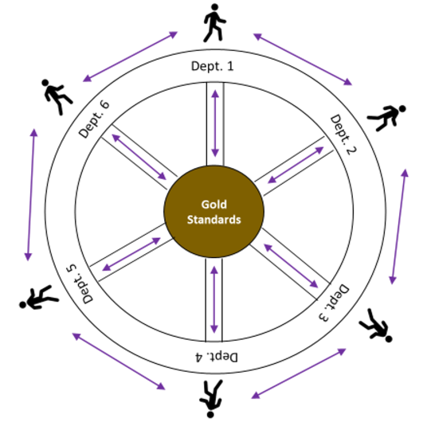
Each academic department would then be responsible for discipline specific integration of these skills as demonstrated in the spokes of the wheel. Most Gold Standards skills would benefit from a second layer of training adjusted to how the gold standards area applies in each discipline or to the individual student’s goals. This could be implemented through various existing opportunities, such as within-department courses or other programs.
As an extension of the interdisciplinary goals of the Gold Standards, students would be encouraged to engage with “Purple Pathways” across departments, fostering additional interactions and learning opportunities relevant to multiple disciplines, though not necessarily meeting the Gold Standards requirements for all students. Departments, with support from the University, would collaborate to develop and highlight these pathways, enabling students from different disciplines with shared interests to easily identify and access them. These pathways may (but not necessarily) fall along lines such as physical sciences, social sciences, arts and humanities or other common shared interests. Note that many of these interdisciplinary experiences already exist as students take courses in other departments, but these potential connections are not always evident and often depend on word of mouth, resulting in differing levels of access for students.
PhD programs could revise degree track requirements and curriculum to adapt to changing career path demands
In some PhD programs, curricula and required experiences are often built to educate students toward careers in academia. It could be worth regularly reviewing course-specific content and the format of milestone requirements (like qualifying exams or dissertations) to assess whether they sufficiently position students for success in a diversity of careers. Faculty would ensure such modifications do not degrade the value of the PhD but are attentive to changing career goals and employer needs. Regular reviews could include alumni surveys, reports from professional associations, current student surveys or other mechanisms that give academic units insights into what their students need.
- Pilot a PhD belonging checkpoint model and incorporate indicators into program review
To offer ongoing, programmatic practice instead of front-loaded orientation, introduce structured checkpoints at key stages of the doctoral lifecycle to support connection, guidance and resource awareness. (See the Graduate Excellence Progress Tool for inspiration.) - Introduce a “multi-mentor” expectation model
Encourage students to build mentoring networks beyond a single advisor, including peer and secondary mentors. See the Mentoring & Advising recommendations for a similar recommendation. - Launch a community micro-grant program
Provide small, flexible funding ($250–$1000) for student-driven and interdisciplinary community-building efforts (e.g., cohort gatherings, research-related community events, affinity-based programming, cross-department initiatives), with attention to under-resourced programs. Collaborate with college and university Advancement to acquire donor-supported funds. - Increase access to writing and research support
Building on existing structures, expand shared, cross-program opportunities that support both academic progress and informal connection.
Develop a continuity toolkit
Provide guidance and templates (e.g., student roles, event planning, communication, handoff documentation) to sustain community-building practices across leadership transitions. - Establish a faculty community steward role
Designate a faculty role to support community-building efforts, connect programming to academic milestones and to promote faculty engagement. Recognize this role as critical departmental service. - Pilot a “Graduate Living Room” through student co-design
Identify underutilized departmental space and invite PhD students to co-design welcoming, flexible spaces that support informal interaction, writing and low-barrier programming. Offer a small budget for food and informal programming.
- Mentoring “micro-credential” for faculty and staff (stackable, optional, recognized)
Develop a short series of 20–30 minute modules (asynchronous, with optional live micro-sessions) that culminate in a visible badge or certificate (e.g., “UW Mentoring Essentials”) and basic recognition (e.g., website listing, annual acknowledgment, small professional development credit). This approach acknowledges the limited effectiveness of compliance-based strategies and instead leverages incentives and social recognition to encourage participation. - “5+ Year Completion Checkpoint” pilot paired with integrated support
When a student reaches a defined time-to-degree threshold (e.g., five years), trigger a structured checkpoint that produces a concrete plan to completion and provides targeted support to make that plan achievable. In addition to a brief advisor status update and milestone timeline, offer an optional “support menu” that programs can use as needed. This may include a committee reset meeting template to clarify roles and scope, a short writing sprint to advance chapters or papers, milestone mapping for the next 6–12 months and referral pathways for mediation or conflict support when mentoring challenges contribute to delays. Pilot this approach in a small set of departments with varied advising models, assess administrative burden and perceived value and refine prior to broader implementation. - MyGrad “optional milestone tracking” extensions (nudges, not mandates)
The Graduate School could introduce optional tracking features within MyGrad that programs can enable based on fit (e.g., early mentoring committee formation, mentoring meetings, pre-general exam milestones). These features provide a consistent structure for reminders and transparency while preserving flexibility. They also reduce “single point of failure” risks by distributing tracking responsibility rather than concentrating it with a single individual. - UW-wide “student empowerment” companion guide + advising conversation prompts
Develop a student-facing guide to complement mentor-focused tools, including checklists, key questions, conversation prompts and guidance on setting expectations, requesting feedback and effectively engaging committees. This resource addresses concerns about mentor–mentee fit and helps normalize proactive, constructive mentoring conversations. - Mentoring circles / peer coaching circles as a scalable support structure
Establish cross-unit mentoring or peer coaching circles for early-stage faculty mentors, Graduate Program Advisors/Graduate Program Coordinators and/or doctoral students. These groups would be structured around practical scenarios—such as setting expectations, providing feedback and preventing or managing conflict—to build communities of practice and spread effective mentoring norms more efficiently than one-time trainings.
Selected Resources
- AI Literacy: UW Libraries AI Guide, AI courses at UW, LinkedIn Learning AI courses
- Communication & Presentation: Scholars’ Studio, Three Minute Thesis, Fellowships & Awards
- Data Analysis: eScience Institute workshops and short courses, UW Tacoma Teaching & Learning Center
- Entrepreneurship & Marketing: UW CoMotion Innovation Training
- Ethical & Responsible Research: RCR Training, Research Compliance
- Leadership & Collaboration: LinkedIn Learning, Graduate student organizations
- Pedagogy: Center for Teaching and Learning
- Project Management: LinkedIn Learning
- Public Engagement: Scholars’ Studio, Community Engagement Knowledge Hub
UW Resources
Central resources
- Career & Internship Center
- Center for Teaching & Learning
- Graduate School (including IDP)
- Simpson Center for the Humanities
Program & unit examples
- Department of Communication professional development courses
- Department of Global Health career services resources
- Department of History “History as a Profession” course
- Department of Sociology career planning resources
- Evans School of Public Policy career development programming
- School of Aquatic and Fishery Sciences professional development course
Planning & career exploration tools
- Beyond the Professoriate (Training Platform)
- ImaginePhD for Humanities & Social Sciences
- Intersect Job Simulations
- myIDP for STEM-oriented disciplines
- PhD Hub for STEM-oriented disciplines
- University of Michigan transferrable skills resources
- University of Pittsburgh career development planning
- Versatile PhD
Institutional models & promising practices
UW resources
- A Vision for Engineering Literacy & Access (AVELA)
- Center for International Relations & Cultural Leadership Exchange (CIRCLE)
- Equity, Justice, and Inclusion Resource Repository
- Graduate Student Affairs (GSA): Three Minute Thesis
- Graduate Student Handbook
- The Graduate Excellence Progress Tool
- The Office of Graduate Student Success
- Office of Minority Affairs & Diversity (OMAD)
- Research Commons: Scholars’ Studio, Graduate Funding Information Service (GFIS), Citation Management
- Resilience Lab
- Writing Support for Grad Students
- Center for Equity and Inclusion, Tacoma campus
UW examples
- Allen School TGIF template
- Geography Graduate Student Association
- Human Centered Design & Engineering “Done Dissertation” Pilot
- PhD orientation and socialization courses: CSE 590X (How to Navigate the PhD program), HCDE 541 (Introduction to PhD Studies)
- Structured mentoring programs: CAS Mentorship Program, Astronomy Mentoring Program
External models
- Cornell University: A Field Guide to Grad School, MAC Doctoral Peer Mentoring Club
- Effective Practices for Physics Programs
- Rice University: Thrive @ Rice
- Stanford University Empowering Your Journey
Appendix
Overview
This appendix describes how the one-year PhD Taskforce was planned and executed to produce evidence-informed, actionable recommendations. The approach was designed to support institutional priorities for PhD education and was guided by values of transparency, shared governance, equity-minded decision-making and accountability to the Graduate School, Provost and academic leadership. The work was led by two chairs, coordinated by a Steering Committee (SteerCo) of ten members (eight faculty and two staff) and two PhD students. The SteerCo divided into five focused working groups with approximately 50 faculty and staff, representing a wide range of disciplines and roles. Across the project, SteerCo members contributed an average of approximately two hours per week to governance, coordination and synthesis. Stakeholder engagement was integrated throughout, including eight town halls open to all faculty and staff and two PhD student listening sessions.
Charge, scope, & guiding principles
The Taskforce was charged by the Office of the Provost and the Graduate School in January 2025 to examine key challenges and opportunities in PhD education at the University of Washington and to develop recommendations that were evidence-informed, actionable and responsive to institutional context.
The Taskforce was intentionally focused on PhD education. As such, professional and practice-oriented doctoral programs—including EdD, MD, PharmD, DDS and JD programs—were outside the scope of this work. This focus enabled the Taskforce to examine issues specific to PhD training, research preparation, sense of belonging, mentoring, funding and career development.
Guiding principles included:
- Transparency and clear communication
- Shared governance and inclusive participation
- Equity-minded decision-making
- Accountability and implementation readiness
Project phase & timeline
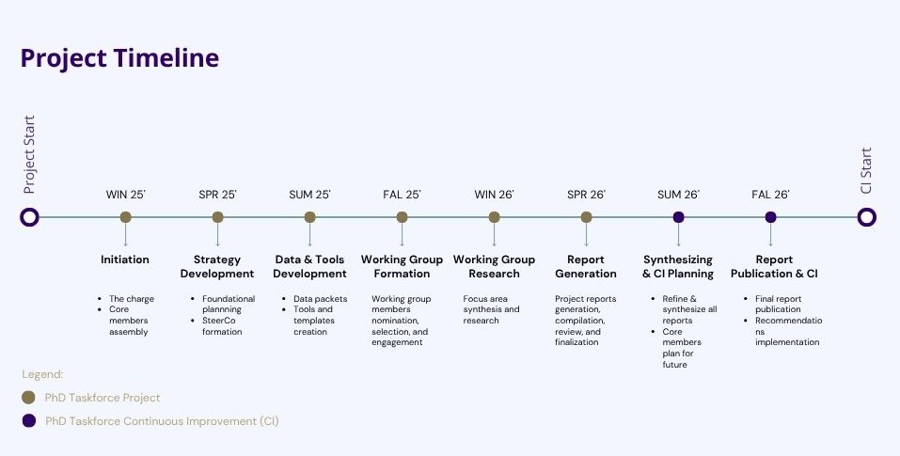
Following its formation, the SteerCo met to review the Taskforce charge and identify the areas where collective effort would have the greatest impact. Through discussion and consensus-building, the SteerCo established five focus areas: Academic Progress & Success (formerly Academic Research & Excellence), Career & Professional Development, Community & Belonging, Funding and Mentoring & Advising. Working group members were subsequently recruited and assigned to support these areas through a structured nomination and selection process.
Foundation & project design
Due to evolving federal policy and funding conditions following the U.S. presidential election, the project was not formally launched until Spring 2025. Joy Williamson-Lott, Dean of the Graduate School, and Daniel Pollack, Divisional Dean of the College of Arts & Sciences, were appointed to serve as co-chairs of the Taskforce. Adele Zhang subsequently joined the Graduate School as Project Manager, Strategic Initiatives, and was charged with supporting the co-chairs in project coordination, stakeholder engagement, and strategic implementation efforts.
The co-chairs selected SteerCo members based on the following criteria: role representation, institutional perspective diversity, experience and expertise, focus area expertise and commitment to equity, collaboration and innovation. Some members were selected based on previous work with the Graduate School while others were nominated by their academic deans. Special attention was given to creating a mix of faculty (eight) and staff (two) from across the University of Washington, including the Seattle and Tacoma campuses, that have deep knowledge and experience in PhD education.
During Winter and Spring 2025, the SteerCo established the project’s strategic foundation by confirming the Taskforce charge, scope and governance structure. Central to this phase was the development of a comprehensive project charter, which defined the project’s goals, scope and boundaries, success metrics, deliverables and key assumptions. The charter also identified priority stakeholder groups and articulated the anticipated institutional benefits of the work.
After populating the SteerCo, working group members were nominated, selected and finalized through a structured process that included a call for nominations, screening and selection.
Infrastructure & capacity building
In Summer 2025, the Taskforce paused its work while the Graduate School focused on building the operational infrastructure required to support distributed and collaborative work across working groups. This included the development of standardized project management tools, templates and guiding materials to ensure consistency in analysis, documentation and reporting.
A dedicated Microsoft Teams channel was established as the central hub for project coordination, documentation and communication. In parallel, a public-facing Taskforce website was developed to advance transparency and broaden public access to project materials. The website served as a central repository for key documents, town hall recordings and project updates, while also enabling community engagement through a structured feedback mechanism.
A related and parallel project in the Graduate School was the production of standardized data packets for academic deans on PhD education that included longitudinal information on cohort size, application yield, time to completion and other metrics to facilitate local decision-making. The co-chairs and the Graduate School’s IT team then delivered structured presentations to academic leadership and local data analysts to ensure their knowledge of this resource.
Stakeholder engagement & structured inquiry
Broad consultation was essential to build legitimacy, surface local assumptions and innovations and enable scaling and adoption. Engagement aligned with shared governance practices and prioritized faculty and staff expertise alongside student voice.
During Fall 2025, the Taskforce transitioned into active engagement and analysis. Working groups refined their own charges and scopes of work and began structured inquiry within their respective focus areas, supported by standardized templates and guiding questions designed to promote analytical consistency and comparability across groups. Working groups conducted informal surveys and structured and unstructured conversations with faculty and staff across the UW to gather information, insights and best practices.
At the same time, the co-chairs implemented a coordinated stakeholder engagement strategy, including eight town halls across the UW community and two dedicated PhD student listening sessions. These efforts were designed not only to gather input, but also to surface diverse perspectives, validate emerging themes and strengthen the connection between the Taskforce’s work and needs in PhD programs.
All main communication channels and high-level information were published on the Taskforce website. The PhD community was also encouraged to use feedback forms available on the project’s landing page to provide anonymous and non-anonymous feedback. Joy responded to all non-anonymous feedback and shared relevant feedback with working group leads.
Synthesis & recommendation development
In Winter and Spring 2026, the Taskforce focused on synthesizing evidence and translating findings into actionable recommendations. Working groups drew upon multiple sources of information—including institutional data, stakeholder feedback, benchmarking research and disciplinary expertise—to identify opportunities for improvement within PhD education and develop recommendations that were both evidence-informed and responsive to the UW context.
The analytical approach intentionally integrated quantitative and qualitative evidence. Institutional datasets, developed in partnership with the Graduate School and central administrative units, provided insight into key indicators such as time-to-degree and funding patterns. Standardized data packets, presentations and an interactive dashboard established a shared evidentiary foundation across academic units and working groups, strengthening consistency in analysis and interpretation.
Quantitative findings were complemented by feedback gathered through town halls, listening sessions, consultations and website submissions. These perspectives helped contextualize institutional trends, identify challenges not readily visible in the data and validate emerging findings. External research and peer-institution benchmarking further informed the analysis by highlighting promising practices and alternative approaches for consideration.
Through iterative review and cross-group coordination, the Taskforce identified shared themes, interdependencies and implementation considerations that cut across focus areas. This process resulted in a portfolio of short-term and long-term recommendations, spanning both centralized and decentralized approaches, while explicitly considering barriers, resource needs and institutional readiness. Together, these practices ensured analytical consistency, strengthened the credibility of findings and supported the development of recommendations that were both evidence-based and responsive to institutional context.
From findings to recommendations
Working groups developed initial findings and recommendations and refined them through iterative cycles of analysis, synthesis and review. Short-term recommendations were designed to be implementation-ready by identifying barriers, dependencies and resource considerations alongside proposed actions while long-term recommendations and innovative ideas reflect an aspirational vision and require greater effort and longer time horizons to implement.
Regular coordination across working groups and SteerCo supported coherence across themes and strengthened alignment of recommendations with institutional priorities.
Continuous improvement : what’s next
The Taskforce is grounded in a continuous improvement framework that spans multiple time horizons and positions this work as the beginning of sustained institutional advancement rather than a discrete initiative. As of AY 2025, the project reports identified actionable opportunities for improvement.
Building on this foundation, the final Taskforce report integrates cross-cutting themes and aligns recommendations within a forward-looking continuous improvement focused framework extending into AY 2026–2027 and beyond. In doing so, the report serves not only as a formal deliverable to the Provost, but as a strategic roadmap to guide iterative implementation, assessment and refinement across successive planning cycles through 2030.
Viewed through a multi-year lens, the Taskforce’s work advances immediate priorities while reinforcing the University’s long-term commitments to excellence in financial resilience, student support, mentoring, career development and research infrastructure. The framework is intentionally designed to enable ongoing learning, adaptation and scaling of effective practices across the institution.
Anchored in a growth mindset, the Taskforce seeks to extend the impact of this effort by fostering a culture of continuous learning and measurable progress, ensuring that improvements in PhD education are both visible and sustained over time.
Selected project management templates
To support consistent implementation and enable reuse beyond the life of the Taskforce, the project identified a set of practical tools and templates. The templates listed below were not developed by the Taskforce; they are publicly available resources that can be curated to support local implementation and adaptation.
References
Academic Leadership Group, Inc. (2025). Creating high-impact mentorship programs for graduate success: Empowering future leaders [Handbook]. Academic Leadership Group.
American Council of Learned Societies. (2024). Public pathways: Lessons about PhD careers from 10 years of Mellon/ACLS public fellows. https://www.acls.org/resources/public-pathways-lessons-about-phd-careers/
Andrews, G., & Shaffer, A. (2025, July 18). Americans’ confidence in higher education increases. Association of American Universities. https://www.aau.edu/newsroom/leading-research-universities-report/americans-confidence-higher-education-increases
Association of American Medical Colleges. (2017a, January). Compact between biomedical graduate students and their research advisors: A framework for aligning the graduate student–mentor relationship [PDF].
Association of American Medical Colleges. (2017b, January). Compact between postdoctoral appointees and their mentors: A framework for aligning the postdoctoral appointee–mentor relationship [PDF].
Association of American Medical Colleges. (n.d.). Appropriate treatment of research trainees. https://www.aamc.org/media/56841/download
Association of American Universities. (2025, July 18). Americans’ confidence in higher education increases. https://www.aau.edu/newsroom/leading-research-universities-report/americans-confidence-higher-education-increases
Bonaparte, S., & Baldasty, J. (2009, July 14). Finding mentors. Inside Higher Ed. https://www.insidehighered.com/advice/2009/07/15/finding-mentors
Cho, C. S., Ramanan, R. A., & Feldman, M. D. (2011). Defining the ideal qualities of mentorship: A qualitative analysis of the characteristics of outstanding mentors. The American Journal of Medicine, 124(5), 453–458. https://doi.org/10.1016/j.amjmed.2010.12.007
Colby, G. (2023, March). Data snapshot: Tenure and contingency in U.S. higher education. American Association of University Professors. https://www.aaup.org/sites/default/files/AAUP%20Data%20Snapshot.pdf
Colby, G. (2025). Data snapshot: Tenure and contingency in U.S. medical schools, fall 2023 [reissue]. Academe, 111(Spring). https://www.aaup.org/academe/issues/spring-2025/data-snapshot-tenure-and-contingency-us-medical-schools-fall-2023
Council of Graduate Schools. (2019, July). Closing gaps in our knowledge of PhD career pathways: Job changes of PhD graduates after earning their degree. CGS Research in Brief. https://cgsnet.org/wp-content/uploads/2022/02/137_19-CGS_CareerPathways_July2019_WebFinal4.pdf
Council of Graduate Schools. (2024). Mentoring resources. https://cgsnet.org/data-insights/graduate-professional-development/mentoring-resources
Council of Graduate Schools. (2024, August 20). Empowering PhD graduates with essential career skills. https://cgsnet.org/wp-content/uploads/2024/08/CGS_CareerPathways_RiB_Empowering-PhD-Graduates_v4.pdf
Council of Graduate Schools. (2025). Understanding and supporting PhD careers: A resource for universities. https://cgsnet.org/wp-content/uploads/2025/04/CGS_Understanding-Supporting_Final.pdf
Council of Graduate Schools. (2026a). Healthy research teams and labs advisory committee framework. Council of Graduate Schools.
Council of Graduate Schools. (2026b). Promising practices for healthy research teams and labs (Appendix). In Healthy research teams and labs advisory committee framework. Council of Graduate Schools.
Council of Graduate Schools. (n.d.-a). 2022 global summit: The evolving role of mentors and supervisors in graduate education. https://cgsnet.org/data-insights/international-engagement/global-summit-on-graduate-education/2022-cgs-global-summit/
Council of Graduate Schools. (n.d.-b). Understanding PhD career pathways for program improvement. https://cgsnet.org/project/understanding-phd-career-pathways-for-program-improvement
Edwards, K., Bai, Z., & Mahoney, B. (2019, January 1). Holistic mentorship. ASBMB Today. https://www.asbmb.org/asbmb-today/careers/010119/holistic-mentorship
Executive Office of the President. (2020, September 28). Combating race and sex stereotyping (Executive Order 13950). Federal Register, 85, 60683–60689. https://www.federalregister.gov/documents/2020/09/28/2020-21534/combating-race-and-sex-stereotyping
Executive Office of the President. (2025, January 31). Ending illegal discrimination and restoring merit-based opportunity (Executive Order 14173). Federal Register, 90, 8633–8636. https://www.federalregister.gov/documents/2025/01/31/2025-02097/ending-illegal-discrimination-and-restoring-merit-based-opportunity
Hardy, T. (2026, September 4). STEM doctoral students: Perceptions of program policies, degree requirements, and available supports (Research in Brief). Council of Graduate Schools, , Creating Learning Environments for Advancing Researchers (CLEAR). https://cgsnet.org/research-brief/stem-doctoral-students-perceptions-of-program-policies-degree-requirements-and-available-supports
Jones, J. M. (2025, July 16). U.S. public trust in higher ed rises from recent lows. Gallup. https://news.gallup.com/poll/692519/public-trust-higher-rises-recent-low.aspx
Kang, J. C. (2026, May 19). The enrollment cliff is here. Which schools will survive it? The New Yorker. https://www.newyorker.com/news/fault-lines/the-enrollment-cliff-is-here-which-schools-will-survive-it
Knott, K. (2025, May 27). Five charts that show how faculty have changed in 20 years. Inside Higher Ed. https://www.insidehighered.com/news/faculty/2025/05/27/five-charts-show-how-faculty-have-changed-20-years
Lu, A. (2025, May 22). “Every revenue source is at risk”: Under Trump, research universities are cutting back. The Chronicle of Higher Education.
Magner, D. K. (2025, May 27). Your Career: A rough job market ahead for Ph.D.s. The Chronicle of Higher Education. https://www.chronicle.com/newsletter/your-career/2025-05-27
Mahoney, B., & Sablan, J. (2023, October 9). Getting the mentoring you need. Inside Higher Ed. https://www.insidehighered.com/opinion/career-advice/2023/10/09/how-grad-students-can-shape-successful-mentoring-relationships
Mallik, T. B. (2021, November 14). Graduate students should seek multiple mentors. Inside Higher Ed. https://www.insidehighered.com/advice/2021/11/15/benefits-phds-having-multiple-mentors-opinion
McNichols, J. (2026, April 24). What does UW’s declining federal money mean for Seattle’s innovation economy? KUOW. https://www.kuow.org/stories/what-does-uw-s-declining-federal-money-mean-for-seattle-s-innovation-economy
Montgomery, B. L. (2017). Mapping a mentoring roadmap and developing a supportive network for strategic career advancement. SAGE Open, 7(2). https://doi.org/10.1177/2158244017710288
MORE Committee. (2024). How to mentor graduate students: A guide for faculty. University of Michigan.
National Academies of Sciences, Engineering, and Medicine. (2019). The science of effective mentorship in STEMM (chapter landing page). https://www.nationalacademies.org/read/25568/chapter/1
National Academies of Sciences, Engineering, and Medicine. (2019). The science of effective mentorship in STEMM. National Academies Press. https://doi.org/10.17226/25568
National Center for Faculty Development & Diversity. (2011). NCFDD mentoring map [Worksheet].
Ortega, S. T., & Kent, J. D. (2018). What is a PhD? Reverse-engineering our degree programs in the age of evidence based change. Change: The Magazine of Higher Learning, 50(1), 30–36. https://doi.org/10.1080/00091383.2018.1413904
Palmer, K. (2025, April 11). The ripple effects of draining the Ph.D. pool. Inside Higher Ed. https://www.insidehighered.com/news/students/graduate-students-and-postdocs/2025/04/11/how-drop-phd-students-could-affect-colleges
Rackham Graduate School, University of Michigan. (n.d.). Quick tips for promising practices: Mentoring [Handout].
Quinn, R. (2026, July 24). White House seeks to steer more research funding away from academia. Inside Higher Ed. https://www.insidehighered.com/news/government/science-research-policy/2026/07/24/white-house-seeks-steer-research-funding-outside
Schalop, A. (2026, February 6). Americans want scientific research. The government cut it anyway. National Education Association. https://www.nea.org/nea-today/all-news-articles/americans-want-scientific-research-government-cut-it-anyway
The Graduate School, Northwestern University. (n.d.). Guidance for positive graduate student and faculty adviser relationships [Guidance document].
U.S. Department of Education, Office for Civil Rights. (2025, March 14). Office for Civil Rights initiates Title VI investigations into institutions of higher education. https://www.ed.gov/about/news/press-release/office-civil-rights-initiates-title-vi-investigations-institutions-of-higher-education
University of Michigan, Rackham Graduate School. (2014). How to get the mentoring you want: A guide for graduate students.
University of Michigan, Rackham Graduate School. (2024). How to mentor graduate students: A guide for faculty.
University of Minnesota Clinical and Translational Science Institute. (n.d.). Online mentor training. https://ctsi.umn.edu/training/mentors/online-mentor-training
University of North Carolina at Chapel Hill, Center for Faculty Excellence. (n.d.). Setting expectations in mentoring relationships (Mentoring toolkit) [PDF]. Retrieved April 5, 2026, from https://cfe.unc.edu/wp-content/uploads/sites/1381/2025/04/CFE_Setting-Expectations_FINAL_TAGGED.pdf
University of Washington ADVANCE. (2022). Peer coaching circles basics [PDF]. https://advance.washington.edu/resources/peer-coaching-circle-basics
University of Washington External Affairs. (n.d.). External & media relations (EIR). https://www.washington.edu/externalaffairs/eir/
University of Washington Graduate School. (n.d.). Mentoring resources for graduate students. https://grad.uw.edu/current-students/student-success/mentoring/
University of Washington Medicine, Office of Research and Graduate Education. (n.d.). Research mentor education. https://research-grad-ed.uwmedicine.org/education/mentor-education/
University of Washington News. (2025, June 18). UW is the No. 8 university in the world according to new U.S. News & World Report rankings. https://www.washington.edu/news/2025/06/18/uw-is-the-no-8-university-in-the-world-according-to-new-us-news-world-report-rankings/
University of Washington Office of Planning & Budgeting. (2013, April 25). UW ranks 1st among public schools and 2nd overall for federal R&D funding. https://www.washington.edu/opb/2013/04/25/uw-ranks-1st-among-public-schools-and-2nd-overall-for-federal-rd-funding/
University of Washington, Department of Astronomy. (2019, September). University of Washington astronomy mentoring program [PDF]. https://astro.washington.edu/sites/astro/files/documents/graduate_mentoring_program_book_sept_2021.pdf
University of Washington External Affairs. (n.d.). External & media relations (EIR). https://www.washington.edu/externalaffairs/eir/
University of Washington, Paul G. Allen School of Computer Science & Engineering. (2025, November). Allen School conflict management student guide: Overcoming interpersonal barriers through professionalism and community. https://docs.google.com/document/d/e/2PACX-1vSGRF0X-7uKnChMbDkm6qpyRBdL-Iv0Jq9x8muyznzwnZ_dqOyQNkTpiRt3aOCn24vjQvhPDkVt-jqq/pub
U.S. Department of Homeland Security. (2026, July 17). Final rule: Establishing a fixed time period of admission and an extension of stay procedure FAQ. Study in the States. https://studyinthestates.dhs.gov/final-rule-establishing-a-fixed-time-period-of-admission-and-an-extension-of-stay-procedure-faq
UW News Staff. (2025, June 18). UW is the No. 8 university in the world according to new U.S. News & World Report rankings. University of Washington News. https://www.washington.edu/news/2025/06/18/uw-is-the-no-8-university-in-the-world-according-to-new-us-news-world-report-rankings/
Wang, X. (2025, February 20). On collaborentoring. Inside Higher Ed. https://www.insidehighered.com/opinion/career-advice/advancing-faculty/2025/02/20/thoughts-collaborative-mentoring-opinion
Wood Lab. (n.d.). Wood Lab guide [Google Doc]. Retrieved April 5, 2026, from https://docs.google.com/document/d/10zhZyhbYsEDdsQ8h1oaCWjxyZ7A2JH-LvjkQBwqaKsY/
Yeager, D. (2024). 10 to 25: The science of motivating young people: A groundbreaking approach to leading the next generation—and making your own life easier. Avid Reader Press.